



Spain has long been a hotspot for cannabis culture, attracting tourists and locals alike with its relaxed attitude toward the plant.
Cannabis has been used in Spain since ancient times, reflecting a long-standing relationship with the plant.
From Barcelona’s famous cannabis clubs to cultivation laws that are unique in Europe, Spain’s cannabis scene has its own set of rules, restrictions, and opportunities.
It’s important to note that cannabis is not completely legal in Spain; its use is tolerated in certain contexts, such as private consumption and within cannabis clubs, creating a legal grey area.
If you’re considering traveling to Spain, living there, or starting a cannabis-related venture, it’s essential to understand the current cannabis laws in Spain.
While Spain is more tolerant than many European countries, it’s not a free-for-all. This guide breaks down the essentials so you can stay informed and avoid legal issues.
Introduction to Cannabis in Spain
Cannabis in Spain is a subject shaped by centuries of history, evolving social attitudes, and a patchwork of modern regulations.
From ancient times, cannabis consumption has been woven into the fabric of Spanish society, and today, the country stands out in Europe for its unique approach to cannabis laws.
However, the legal status of cannabis in Spain is far from straightforward, with a complex web of rules governing cannabis cultivation, cannabis clubs, medical cannabis, and personal use.
Under Spanish law, cannabis use and possession for personal consumption are decriminalized when kept within private spaces, creating a legal grey area that has given rise to the country’s famous cannabis social clubs.
These private clubs allow members to obtain cannabis for personal use, but they operate in a legal limbo and are not always recognized by authorities.
While cannabis cultivation is permitted for personal use, the law does not specify the exact number of cannabis plants allowed—though two plants per person is often cited as a guideline.
Growing cannabis for commercial purposes or distributing it to others is considered drug trafficking or cannabis trafficking and is treated as a serious criminal offense.
Medical cannabis is available in Spain, but access is tightly regulated and limited to certain conditions such as multiple sclerosis and chronic pain.
The Spanish government has established a system for distributing medical cannabis, but the process can be slow and bureaucratic, leaving many patients to seek relief through cannabis clubs or other means.
The landscape of cannabis laws in Spain is further complicated by the country’s autonomous communities, each of which may have its own approach to regulating cannabis use, possession, and cultivation.
Political parties continue to debate the future of cannabis legalization, and the European Union’s lack of a unified policy adds another layer of complexity.
For anyone interested in cannabis in Spain, whether for recreational use, medical purposes, or cultivation, it is essential to understand the current laws in Spain and the potential legal repercussions.
Staying informed about the latest regulations, especially as they evolve, is crucial to avoid criminal offenses and ensure compliance.
As the debate around regulating cannabis continues, Spain remains a fascinating example of how tradition, law, and culture intersect in the world of cannabis.
Is Cannabis Legal in Spain?
Cannabis in Spain exists in a grey area. It is not legal, but under certain circumstances, it is decriminalized. Here’s what you need to know:
- Private use is tolerated – Adults can consume cannabis in the privacy of their own home.
- Personal cultivation is allowed – You may grow cannabis plants for your own use as long as they are not visible to the public. However, Spanish law does not specify an exact number of plants allowed for personal use, which adds to the legal ambiguity and grey area surrounding cultivation.
- Public possession and use are illegal – Carrying cannabis in a public place, or smoking it on the street, can result in fines of €300–€600 and confiscation.
- Cannabis sales are prohibited – Commercial sale, trafficking, or transportation of cannabis is illegal and can lead to criminal charges.
Smoking cannabis is also illegal in other public places such as swimming pools and outdoor terraces.
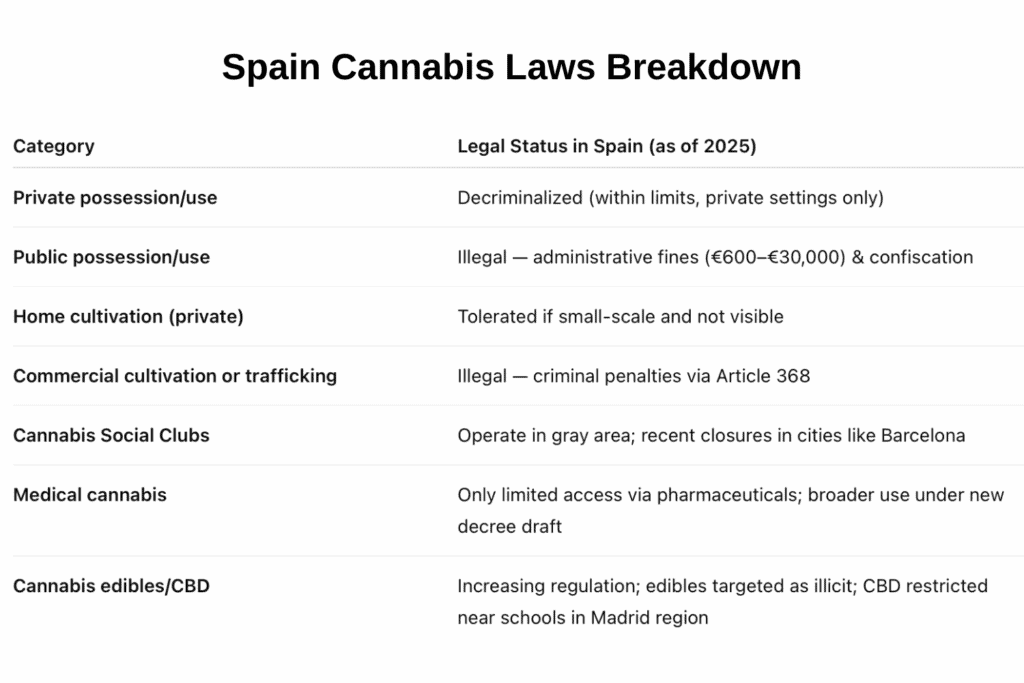
Cannabis Possession Laws in Spain
Cannabis possession laws in Spain are shaped by a mix of national and regional regulations, making the legal landscape complex.
Under Spanish law, cannabis possession for personal consumption is decriminalized when it takes place in private spaces.
Individuals are generally tolerated to possess up to 100 grams of cannabis for their own use at home, as long as it is not intended for distribution or sale.
However, this tolerance does not extend to public places—carrying or consuming cannabis in public is strictly illegal and can result in fines ranging from €300 to €600, along with confiscation of the substance.
It’s important to note that laws in Spain can vary between autonomous communities, with some regions enforcing stricter or more lenient policies regarding cannabis possession.
Regardless of where you are in the country, public possession is always subject to penalties, and being caught with cannabis outside of private property can lead to legal repercussions.
For anyone living in or visiting Spain, understanding the specific laws in your region is essential to avoid fines and ensure compliance with local regulations.
Cannabis Social Clubs in Spain
One of Spain’s most unique features is the cannabis social club system, particularly popular in Barcelona and parts of Catalonia. There are approximately 500-700 cannabis clubs operating in Spain.
Cannabis social clubs exist throughout Spain as private organizations where members can legally grow and consume cannabis.
- What They Are: Cannabis clubs are private, non-profit associations operating as private places due to legal loopholes, where members collectively grow and distribute cannabis.
- How They Work: Members pay a membership fee, which covers cultivation costs, to join a cannabis club and then receive cannabis for personal consumption. One must also sign a declaration.
- Membership Rules: You must be invited by an existing member, be over 18 (sometimes 21), and agree to consume only within the club or privately.
- Legal Loophole: These clubs operate under the protection of private use laws, but they remain in a legally gray zone. Some clubs have faced police crackdowns.
Such clubs exist throughout Spain, especially in Catalonia, due to this legal grey area. However, organized cultivation and distribution within these clubs can be considered drug trafficking and may result in criminal offenses.
Cannabis clubs do not advertise publicly and can be difficult to locate without insider knowledge.
Cannabis associations play a significant role in advocating for regulation and legalization, influencing cannabis policy reform and public opinion in Spain.
Cannabis Cultivation Laws in Spain
Spain allows limited personal cultivation of cannabis plants:
- Allowed: Growing cannabis for personal use in private spaces where plants are not visible from the street. Some sources mention a limit of two plants per person, but Spanish law does not specify an exact number, which contributes to the legal grey area.
- Not Allowed: Large-scale cultivation, visible plants, or growing with the intent to sell.
- Legal Risks: A person caught exceeding personal cultivation limits may be fined or face charges. Large-scale cultivation or intent to distribute can be classified as drug trafficking or cannabis trafficking under Spanish law. Police raids are rare for small, private grows, but larger operations may result in criminal charges.
Industrial Hemp Regulations in Spain
Industrial hemp cultivation in Spain is fully legal, provided growers adhere to strict regulations set by both the Spanish government and the European Union.
Farmers are permitted to cultivate hemp as long as the plants contain less than 0.2% THC, in line with EU directives.
Spain’s favorable climate, boasting around 2,500 hours of sunshine each year, allows for multiple hemp harvests annually, making the country an attractive location for hemp production.
Royal Decree 1729/1999 outlines the legal framework for industrial hemp, authorizing the cultivation of 25 specific hemp varieties.
To be considered legal, all hemp seeds used must be EU-certified. The industrial hemp sector in Spain is expanding rapidly, with more farmers recognizing the crop’s versatility and profitability.
From textiles to construction materials and CBD extraction, industrial hemp is becoming an increasingly important part of Spain’s agricultural economy.
CBD Legal Status in Spain
The legal status of CBD in Spain is relatively straightforward: CBD products are legal as long as they are derived from hemp and contain no more than 0.2% THC, in accordance with EU regulations.
Recently, the European Union raised the maximum THC threshold for industrial hemp to 0.3%, and Spain has aligned its policies with this update. As a result, CBD legal products are widely available throughout the country, from wellness shops to pharmacies.
The Spanish government has not opposed the EU’s stance on CBD, and Spain is quickly emerging as a significant market for CBD products.
However, it’s crucial for consumers and businesses to ensure that all CBD products comply with both EU and Spanish import and labeling requirements.
Any product containing more than 0.3% THC is considered illegal and subject to enforcement. As the demand for CBD continues to grow, Spain’s clear legal framework is helping to foster a thriving market for these products, benefiting both consumers and the country’s industrial hemp industry.
Medical Cannabis in Spain
Unlike countries such as Germany or Portugal, Spain’s medical cannabis framework is limited.
- Legal Status: Medicinal cannabis-based medications (like Sativex) are legal for multiple sclerosis and certain conditions.
- Wider Medical Access: Spain has yet to create a comprehensive medical cannabis program, though the government approved a plan in 2022 to explore regulated distribution in pharmacies. Many patients with chronic pain rely on cannabis for relief.
- Cannabis Clubs for Patients: Due to the limited availability of medicinal cannabis products, many medical patients join cannabis clubs to obtain cannabis for their needs.
Sativex is one of the only cannabis-based medicines sold in Spain, but it is hard to obtain due to its high cost.
Epidiolex is also a cannabis-based medicine, but its use is restricted and not marketed in Spain.
The Spanish Observatory for Medicinal Cannabis (OECM) advocates for patient access to cannabis treatments.
Cannabis Tourism in Spain
Spain is often compared to Amsterdam, but the cannabis culture is very different. Recreational use of cannabis is not fully legalized in Spain, and the laws are stricter than many expect:
- Not for Public Use: Tourists cannot legally buy cannabis in shops or smoke cannabis in public. Other forms of cannabis, such as edibles or concentrates, are also not legally available to tourists.
- Clubs for Tourists? Some cannabis social clubs accept tourists, but you typically need an invite from a member, and rules are stricter in Barcelona due to government pressure.
- Events and Culture: Cannabis expos like Spannabis in Barcelona highlight the country’s thriving cannabis culture.
Penalties for Breaking Cannabis Laws in Spain
- Public Consumption: €300–€600 fine.
- Possession in Public: Fines and confiscation.
- Trafficking/Sales: It is illegal to sell cannabis in Spain. Trafficking or large-scale cultivation and distribution are considered criminal offenses under Spanish law and can result in prison sentences. Penalties depend on the quantity and circumstances.
- Crossing Borders: Taking cannabis or other drugs and substances into or out of Spain is a crime under EU and international law.
Cannabis is classified among other drugs and substances in Spanish regulations, with varying penalties depending on the type of criminal offenses and the role of the substance involved.
Future of Cannabis in Spain
- Political Debate: Spain’s parliament has debated legalization multiple times, with different political parties and each political party holding varying stances on cannabis legalization. Regulating cannabis remains a key issue in parliamentary debates, with some political parties supporting reforms and others opposing them. In 2017, the Catalan Parliament attempted to regulate cannabis use, cultivation, and distribution, but this law was quickly overturned by the Constitutional Court for infringing on national authority. Changes in cannabis laws could significantly impact young people, particularly by influencing their perceptions of safety and potentially increasing usage rates among teenagers.
- Public Support: Surveys show a majority of Spaniards support medical cannabis and regulated adult use.
- EU Influence: Spain is watching developments in Germany, Malta, and Luxembourg, where legalization is progressing.
FAQs About Cannabis Laws in Spain
Can you smoke weed in public in Spain?
No. Public cannabis use is illegal and carries fines. Only private cannabis use is tolerated, and laws vary by region.
Can tourists join cannabis clubs in Barcelona?
Yes, but usually by invitation from an existing member. Clubs are private, not open to walk-ins. Cannabis consumption is allowed inside the club for members only.
How many plants can I grow at home?
There’s no exact legal limit, but growing cannabis must be for personal use and kept out of public view.
Is CBD legal in Spain?
Yes, CBD products are widely available if they contain less than 0.2% THC. However, CBD is regulated under EU rules.
How can I obtain cannabis in Spain?
To obtain cannabis legally, individuals can join a cannabis social club or grow their own for personal use in private spaces. Public sales and purchases are illegal, and medicinal cannabis products are limited.
Will Spain legalize weed in 2026?
Possibly. Political momentum is growing, but as of now, Spain has not fully legalized cannabis.
Reviews & Perspectives
Tourist Perspective: “Visiting Barcelona's cannabis clubs was amazing. It's more discreet than Amsterdam, but the quality and community vibe were incredible.”
Local Perspective: “Cannabis laws here are confusing. At home, you're fine, but once you step outside, fines are waiting.”
Expert Opinion: “Spain's cannabis model is unique but unstable. Without full legalization, clubs and users remain vulnerable to changing enforcement.”
Final Thoughts
Spain's cannabis laws strike a balance between tolerance and restriction. While private use and cultivation are permitted, public possession and sales remain illegal.
Cannabis social clubs offer a unique middle ground, making Spain one of the most fascinating cannabis destinations in Europe.
If you're in Spain, the safest way to enjoy cannabis is privately and responsibly—and if you visit a social club, make sure you follow the rules.

Fred Hernandez
Fred Hernandez is a highly accomplished and versatile writer, boasting an extensive background in the cannabis industry. With an in-depth understanding of various sectors including cultivators, processors, retailers, and brands, Fred's expertise spans across the entire cannabis landscape. As a prominent contributor to CTU, he consistently delivers insightful articles exploring the latest developments, news, and regulations shaping the cannabis industry. Whether it's delving into the intricacies of cannabis products, cannabis strain reviews, or providing comprehensive analyses of cannabis laws, or sharing expert insights on cannabis cultivation techniques, Fred's wealth of knowledge positions him as an invaluable writer and educator for all cannabis-related subjects.



 Jeff was involved in an accident where he endured a traumatic brain injury. He had a week-long stay in ICU where brain surgeons
  100% risk free money back guarantee within 48 hours after purchase if student has not completed any of the courses or exams.
