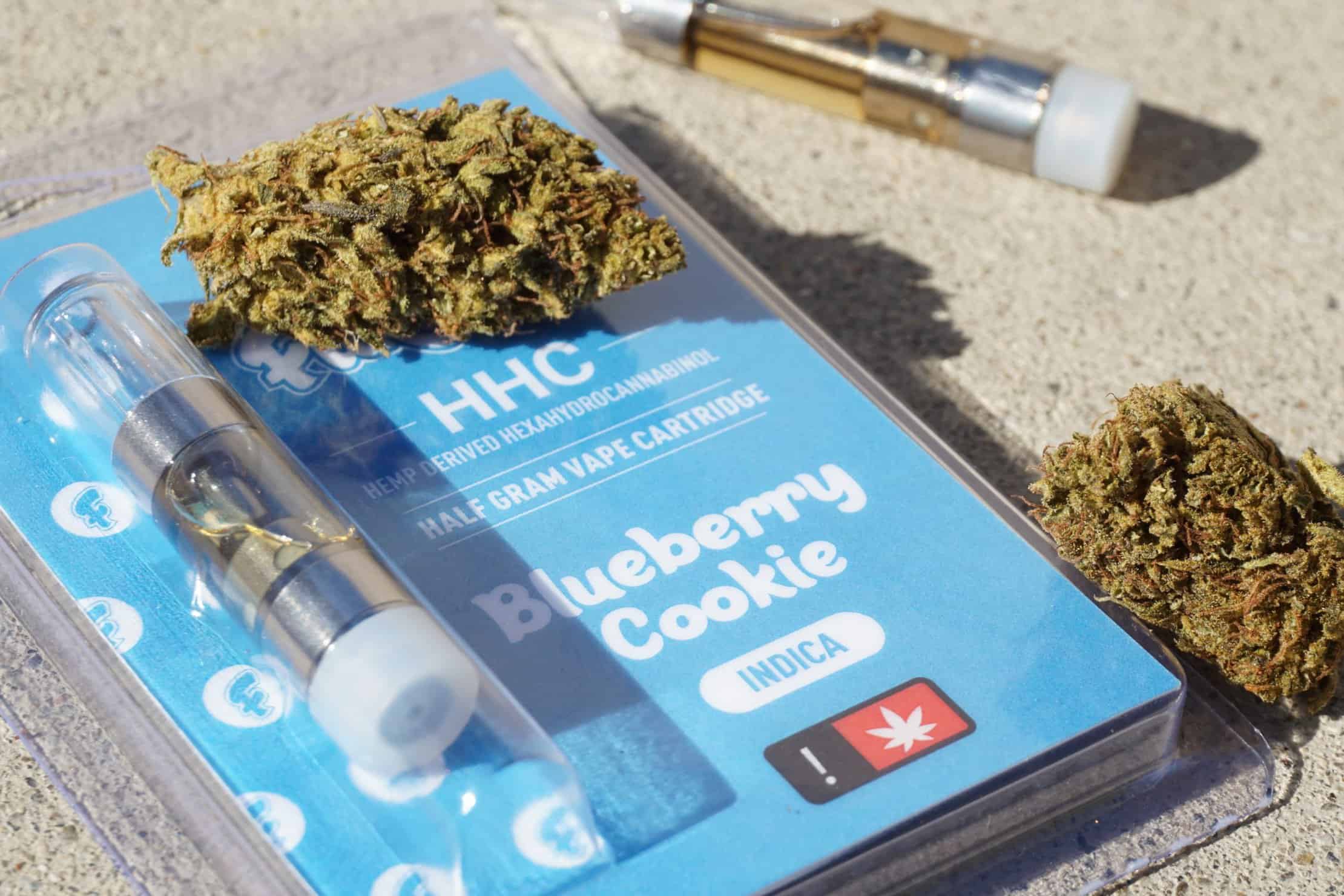
Hexahydrocannabinol (HHC) is one of a few minor naturally-occurring compounds in cannabis gaining popularity in the legal cannabis market.
Although HHC product sales are increasing, many questions exist about its safety, legality, effects, potency, and use.
Here’s what you need to know about HHC vs THC.
Hexahydrocannabinol (HHC) is a relatively minor and little-known cannabinoid rarely found in trace quantities in the plant. Its low content in cannabis does not make it cost-effective to produce. However, HHC extraction from hemp plants is ramping up.
HHC was first synthesized in 1944 by American chemist Roger Adams after adding two hydrogen molecules to delta-9 tetrahydrocannabinol (THC). The hydrogenation process, also used to make vegetable oil, converts THC to HHC.
Most HHC products are derived from low-THC hemp, a legal variety of cannabis containing less than 0.3% THC. Compared to THC products, HHC products are believed to have a longer shelf-life and are less sensitive to heat and UV light.
Delta-9 THC (THC) is the primary, intoxicating cannabinoid in the cannabis plant that produces euphoria, energy, mood boost, and relaxation. THC is federally illegal but can be present in hemp plants if it does not go above 0.3% concentration by dry weight.
Cannabidiol (CBD) is the second most common compound found in greater concentrations in hemp plants. CBD does not produce intoxication but may produce other health benefits associated with THC.
HHC concentrates are made through a complex cannabis extraction process that usually starts with the hemp plant, not high-THC cannabis. HHC may also be derived from THC and citronellal and olivetol terpenes.
Processors extract CBD from the raw material. The CBD extract is distilled to remove unwanted compounds and isolated into a powder form.
Adding a metal catalyst like palladium to the cannabinoid helps speed up the hydrogenation process, which creates HHC.

HHC effects are not well-known or studied. However, users report feeling happier, more energized, and a subtle euphoric boost after consuming HHC.
The active version of HHC is 9R HHC, which binds to cannabinoid receptors while 9S HHC does not. 9S HHC molecules are the inactive HHC molecules.
Does HHC make you high? Yes, but it’s not as potent as THC. Many users say it feels like a weaker version of delta-8 THC, which is about half as potent as THC.
As a relatively unknown compound, there are not many studies on HHC.
Not much is known about HHC’s side effects apart from anecdotal reports. Users report feeling similar side effects to THC, including paranoia, anxiety, dry and red eyes, dry mouth, insomnia, and increased appetite.
There are many differences between THC and HHC. For one, they have a different chemical structures. The only chemical difference is that HHC has two hydrogen molecules not present in THC. HHC is also weaker in potency than THC.
Delta-8 THC is another minor cannabinoid that is growing in popularity. Many consider it a hemp-derived THC since it produces similar effects. According to users, HHC has a weaker potency than delta-8 THC, which is about half as potent as THC.
HHC is currently in a legal grey area. Since it is usually made with hemp plants, many believe it is federally legal under the 2018 Farm Bill.
However, under the Federal Analogue Act, HHC may be considered an analog of THC, a Schedule I drug since it produces similar intoxicating effects.
In May 2022, a federal court in California ruled that delta-8 THC is legal under federal law based on the 2018 Farm Bill, which legalized hemp derivatives. Still, other courts can have different rulings and states can restrict or ban these hemp-derived cannabinoids that are intoxicants.
It’s unclear whether HHC is a safe cannabinoid to consume if you plan on getting drug tested. Urine drug tests, the most popular drug test, detect 11-hydroxy-THC, a THC metabolite produced in the digestive tract.
Anecdotal reports suggest that HHC is relatively safe for those who may need to be drug tested, but you may trigger a positive result if your product has high levels of THC.
We do not recommend using HHC products if you operate heavy machinery or are in a safety-sensitive job.
Since HHC products are relatively new and no comprehensive studies have determined the short and long-term effects of HHC consumption, there is no conclusive guidance on the safety of its use.
Hemp-derived cannabinoid products are not regulated by the Food and Drug Administration (FDA), although warning letters are sent to flagrant violators.
We recommend buying from HHC manufacturers with independent testing results for potency and purity.
We do not recommend making HHC at home since the metal catalyst can ignite and cause an explosion under unsafe conditions. HHC manufacturers produce the extract in a laboratory setting with the proper safety precautions.
If you are ready to hop on the HHC bandwagon, there are many products you can try, including vape carts, concentrates, edibles, and tinctures. Vapes provide fast-acting effects that can last 2-3 hours.
Edibles, such as HHC gummies, take 1-2 hours to kick in but can provide up to 8 hours of effects. HHC flower is hemp flower coated in an HHC extract.
HHC-O, also known as HHC acetate, is made by adding the chemical acetic anhydride to HHC compounds, increasing their binding capacity to receptors in the body for a more potent effect.
Some manufacturers claim that HHC-O is 1.5-3 times stronger than HHC.
THC is hydrogenated into HHC. HHC is more stable and less oxidized after hydrogenation, like margarine. HHC is less studied and known than THC.
HHC is psychotropic, but probably not as much as THC. Though its effects vary, consumers report feeling more calm and less agitated than with THC.
Different jurisdictions legalize HHC and THC. THC is prohibited nationally but legal in several states for medical or recreational usage. HHC’s legality is unclear. It’s commonly touted as a legal alternative to THC because it’s made from hemp-derived CBD, but state laws and the 2018 Farm Bill can affect its legality.
The health consequences of HHC are less studied than THC. THC can relieve pain, stimulate appetite, and reduce anxiety, but it can also produce paranoia and cognitive impairment. HHC’s health and negative effects remain unknown, requiring prudence and research.
There is little data on whether routine drug testing identify HHC. Since it is a THC derivative, it may metabolize in a way that drug tests can detect, but additional research is needed.
Both HHC and THC can be smoked, vaped, or eaten. Due to potency and effect variances, dose may need adjusting. Always start with a minimal dose, especially when attempting a new cannabis.
Most people think THC is stronger than HHC. HHC users report milder effects, suggesting it is less psychotropic than THC.
Some favor HHC for its softer, less anxiety-inducing effects. Its stability and oxidation resistance benefit storage and shelf life. The benefits are subjective and depend on individual preferences and reactions.
Cannabis Training University’s Master of Cannabis program provides a complete education on how cannabis works, how to grow cannabis, how to cook with or extract cannabis, and how to start a cannabis job or business. Enroll at CTU, an IACET Accredited Provider and online cannabis school, today!
More in Cannabis 101

Check your state's cannabis laws

 IACET Accredited Provider · online cannabis education
Since 2009 • 50,000+ students trained worldwide


Copyright Cannabis Training University, a subsidiary of Online Training Providers. © 2026. All Rights Reserved.
Medical Disclaimer: The information on this website is for informational purposes only and is not intended to be a substitute for professional medical advice, diagnosis, or treatment.
Always seek the advice of a physician or other qualified health provider with any questions you may have regarding a medical condition.
Legal Compliance: Cannabis remains federally illegal. Products and information are intended only for jurisdictions where cannabis use and possession is legal.
By using this site, you affirm that you are of legal age (21+) and responsible for understanding your local laws.