State cannabis laws · NC
North Carolina cannabis laws (2026)
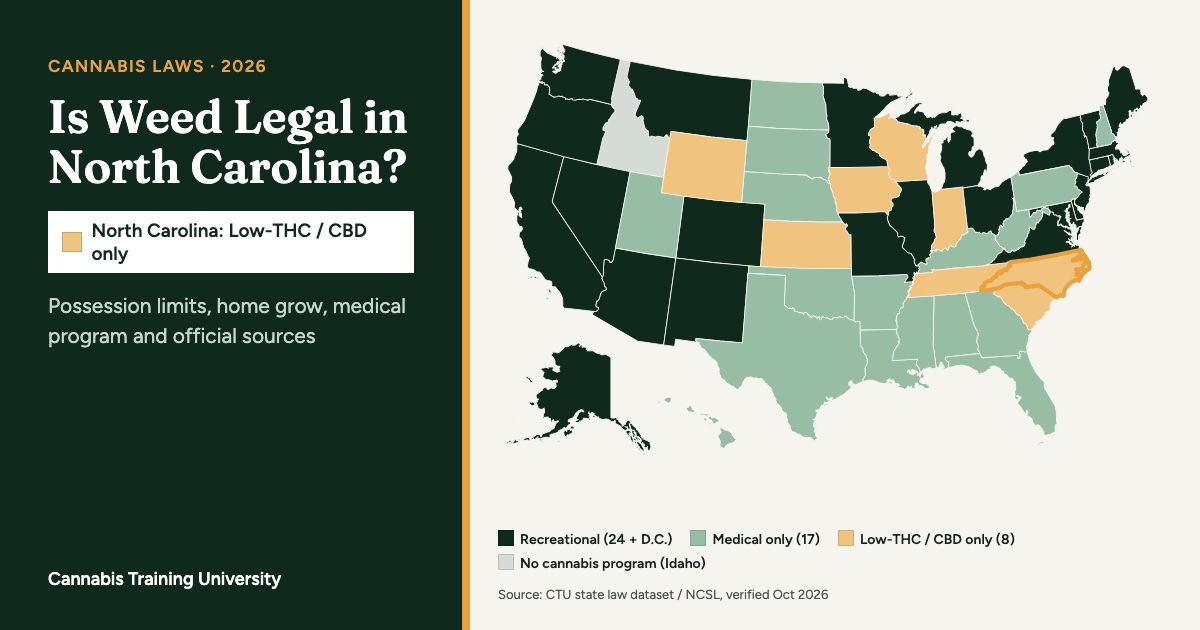
North Carolina prohibits marijuana for both medical and recreational use; possession, cultivation, sale, and distribution remain criminal offenses under G.S. 90-95, with marijuana classified as a Schedule VI controlled substance.
Low-THC / CBD onlyPossession
Home grow
Medical card
Driving (DUI) limit
Decriminalized
Hemp
From the CTU state cannabis law dataset (September 28, 2026), checked against official state sources (numbers point to the Sources list). Facts we have not confirmed on an official source are left out until they are.
North Carolina prohibits marijuana for both medical and recreational use; possession, cultivation, sale, and distribution remain criminal offenses under G.S. 90-95, with marijuana classified as a Schedule VI controlled substance. A narrow exemption (G.S. 90-94.1) lets registered caregivers possess and administer low-THC (under 0.9%) hemp extract to patients with intractable epilepsy, and a Compassionate Care Act medical marijuana bill has repeatedly passed the Senate but stalled in the House. Industrial hemp cultivation is legal, though North Carolina transferred hemp regulatory authority to the USDA in 2022. Hemp-derived CBD products are broadly legal under the 2022 Farm Act.
Official sources G.S. 90-94 Schedule VI controlled substances (NC General Assembly) 1 · H 1011 NC Compassionate Care Act, 2025-2026 session (NC General Assembly) 2 · North Carolina Marijuana Possession, Sale, and Trafficking Penalties – G.S. 90-95 3 · Hemp in NC – NC Department of Agriculture and Consumer Services 6
Adult-use recreational marijuana is illegal everywhere in North Carolina under state law. Possessing, cultivating, selling, or delivering marijuana is a crime for adults of any age under G.S. 90-95, with penalties ranging from a Class 3 misdemeanor for small amounts to felony trafficking charges for large quantities. The one exception is the Qualla Boundary, tribal land of the Eastern Band of Cherokee Indians, where the tribe legalized recreational cannabis by referendum in 2023; that legalization applies only on tribal land and does not change North Carolina law elsewhere.
Official sources G.S. 90-94 Schedule VI controlled substances (NC General Assembly) 1 · Hemp in NC – NC Department of Agriculture and Consumer Services 6
North Carolina has no regulated medical marijuana program. The Compassionate Care Act (Senate Bill 3), which would create a medical cannabis program with qualifying conditions and physician certification, passed the Senate in 2022 and again in 2023 but stalled in the House and remains unenacted. The state's only medical cannabis-related law is a narrow 2014 exemption (G.S. 90-94.1) letting a caregiver possess and administer hemp extract (under 0.9% THC, at least 5% CBD) to a patient with intractable epilepsy, with no state patient registry, ID card, physician certification requirement, or cap on how much a patient may consume.
Official sources H 1011 NC Compassionate Care Act, 2025-2026 session (NC General Assembly) 2 · Hemp Extract Exemption for Intractable Epilepsy – G.S. 90-94.1 7
North Carolina sets no legal possession limits for recreational or medical cannabis because neither program exists. Under the criminal penalty scheme, possessing 0.5 ounces or less of marijuana is a Class 3 misdemeanor (maximum $200 fine, no active jail time), 0.5 to 1.5 ounces is a Class 1 misdemeanor, and more than 1.5 ounces up to 10 pounds is a felony. Possessing more than 10 pounds triggers trafficking felonies with mandatory minimum prison terms. Concentrate thresholds are lower: possessing more than 0.15 ounces of hashish is a felony. Apart from legal hemp (0.3% THC or less), the only lawful possession of a cannabis extract is hemp extract (under 0.9% THC, at least 5% CBD) held by a caregiver to treat intractable epilepsy.
Official sources North Carolina Marijuana Possession, Sale, and Trafficking Penalties – G.S. 90-95 3 · N.C. Gen. Stat. § 15A-1340.23 8 · Hemp Extract Exemption for Intractable Epilepsy – G.S. 90-94.1 7
North Carolina has no legal retail market for marijuana in any form, so there are no state rules for who may purchase cannabis, from where, or in what amount. The only cannabis-adjacent product legally available for purchase is hemp-derived CBD, broadly legal since the 2022 Farm Act and sold at ordinary retail with no comprehensive state licensing or age-verification requirement as of September 2026. The intractable-epilepsy hemp-extract exemption does not create a purchase or dispensing system; it only shields qualifying possession and administration from prosecution.
Official sources N.C. General Assembly, Senate Bill 455 / SL 2022-32 9 · G.S. 90-87 Definitions (NC General Assembly) 4 · N.C. General Assembly, House Bill 328 (2025-2026) Regulate Hemp-Derived Consumables 10 · Hemp Extract Exemption for Intractable Epilepsy – G.S. 90-94.1 7
Home cultivation of marijuana is illegal in North Carolina for any purpose, medical or recreational, and for any person, including caregivers. Growing marijuana is prosecuted under G.S. 90-95, with penalties scaling from a felony for small amounts up to mandatory-minimum trafficking felonies for 10 pounds or more. The only exception is the Qualla Boundary, land of the Eastern Band of Cherokee Indians, where tribal law (not state law) allows cannabis. Growing federally compliant industrial hemp remains legal and is now regulated by the USDA rather than the state.
Official source G.S. 90-87 Definitions (NC General Assembly) 4
North Carolina treats all unlicensed marijuana activity as criminal. Possessing 0.5 ounces or less is a Class 3 misdemeanor (fine up to $200, no active jail time); 0.5 to 1.5 ounces is a Class 1 misdemeanor; more than 1.5 ounces up to 10 pounds is a felony. Selling, delivering, or cultivating any amount is at least a felony, and trafficking over 10 pounds carries escalating mandatory minimum prison terms and a fine of at least $200,000 at the top tier. Enhanced felonies apply for sales near schools or parks. Impaired driving involving marijuana is a misdemeanor judged on impairment, not a numeric THC limit. First-time offenders may qualify for conditional discharge and dismissal after probation.
Official sources North Carolina Marijuana Possession, Sale, and Trafficking Penalties – G.S. 90-95 3 · Possession of Drug Paraphernalia – G.S. 90-113.22 11 · Impaired Driving Law – G.S. 20-138.1 5 · N.C. Gen. Stat. § 15A-1340.23 8
Because North Carolina has no legal marijuana market, it sets no statewide potency caps, labeling rules, or packaging requirements for marijuana products. The one current product-specific rule is that lawful hemp extract under G.S. 90-94.1 must be under 0.9% THC and at least 5% CBD, verified by a certificate of analysis.
Federal hemp change: from December 11, 2026 the federal definition of hemp counts total THC, including THCA, and final hemp products with more than 0.4 mg of total THC per container are no longer hemp; products with cannabinoids the plant cannot naturally produce stop counting as hemp on November 12, 2026. What changes, state by state (P.L. 119-37 § 781; P.L. 119-103 § 2019).
Official sources Hemp Extract Exemption for Intractable Epilepsy – G.S. 90-94.1 7 · Hemp in NC – NC Department of Agriculture and Consumer Services 6
North Carolina collects no cannabis excise or sales tax because it has no legal cannabis market. Its only cannabis-related tax is an unauthorized substances (drug stamp) tax under G.S. 105-113.107, assessed on people illegally possessing marijuana, at $3.50 per gram (40 cents per gram for separated stems and stalks). There is no legal medical or local cannabis tax, and no cannabis tax revenue or revenue projections exist for the state.
Official source Excise Tax on Unauthorized Substances – G.S. 105-113.107 12
North Carolina has no licensed marijuana business structure of any kind: no retail, cultivation, processing, or dispensary licenses exist because marijuana remains illegal statewide, so there is no license cap, application fee, residency requirement, vertical-integration rule, or lottery system. Hemp cultivation, once licensed by the state, is now regulated solely by the USDA after North Carolina repealed its hemp pilot program authority in 2022. Retail sale of hemp-derived CBD and other hemp consumables operates with essentially no state licensing, age-verification, or testing regime as of September 2026, though legislation to create one has been proposed but not enacted.
Official source Hemp in NC – NC Department of Agriculture and Consumer Services 6
Every fact on this page comes from the CTU state cannabis law dataset and is checked against the official government sources below. The numbers match the markers next to each fact and section. Page last reviewed October 6, 2026.
Facts we could not confirm on an official government source are left off this page. Statutes are linked to the state’s own legislature or code site, never to a private copy.
Free to quote and link for research, teaching and news. Please name Cannabis Training University, link this page and give the review date.
APA
Cannabis Training University. (2026, October 6). Is weed legal in North Carolina? North Carolina cannabis laws (2026). https://cannabistraininguniversity.com/laws/is-weed-legal-in-north-carolina/
MLA
“Is Weed Legal in North Carolina? North Carolina Cannabis Laws (2026).” Cannabis Training University, 6 Oct. 2026, cannabistraininguniversity.com/laws/is-weed-legal-in-north-carolina/.
Free to use: download the data (CSV) or add the map to your website.
Official sources Hemp Extract Exemption for Intractable Epilepsy – G.S. 90-94.1 7 · N.C. Gen. Stat. § 90-113.102 (former caregiver registration) 13 · National Park Service, Shenandoah NP Alcohol and Drug Policy 14 · TSA: What Can I Bring? Medical Marijuana 15
Cannabis Training University teaches cannabis skills online: budtending, growing and running a cannabis business.
No. North Carolina has no licensed cannabis dispensaries.
Possessing 0.5 ounces or less of marijuana is a Class 3 misdemeanor with a maximum $200 fine and no active jail time; 0.5 to 1.5 ounces is a Class 1 misdemeanor; more than 1.5 ounces up to 10 pounds is a felony.
No. Recreational cannabis is not legal in North Carolina, for residents or visitors. North Carolina has no medical marijuana card program; its narrow hemp-extract law lets registered epilepsy patients and their caregivers lawfully possess hemp extract obtained from other states that allow it to cross state lines.
Home cultivation of marijuana is illegal in North Carolina for any purpose, medical or recreational, and for any person, including caregivers.
There is no adult-use legalization measure on North Carolina's November 3, 2026 ballot (checked October 15, 2026).
North Carolina sets no legal possession limits for recreational or medical cannabis because neither program exists.
Find it in North Carolina
Check another state's cannabis laws
Pick your state to see possession limits, home grow rules and the official source.
More in Laws


Compliance, regulations, risk reduction
 IACET Accredited Provider · online cannabis education
Since 2009 • 50,000+ students trained worldwide
IACET Accredited Provider · online cannabis education
Since 2009 • 50,000+ students trained worldwide
Copyright Cannabis Training University, a subsidiary of Online Training Providers. © 2026. All Rights Reserved.
Medical Disclaimer: The information on this website is for informational purposes only and is not intended to be a substitute for professional medical advice, diagnosis, or treatment.
Always seek the advice of a physician or other qualified health provider with any questions you may have regarding a medical condition.
Legal Compliance: Cannabis remains federally illegal. Products and information are intended only for jurisdictions where cannabis use and possession is legal.
By using this site, you affirm that you are of legal age (21+) and responsible for understanding your local laws.