



Cannabis decarboxylation is an essential step in the preparation of plant matter or extracts for consumption. Let's learn how to decarb weed the right way each time.
If you do not “decarb” weed before your infusions, you will not activate the plant’s primary therapeutic compounds, including delta-9 tetrahydrocannabinol (THC) and cannabidiol (CBD).
The cannabis decarboxylation process, done the right way, has many variables depending on the cannabis material, decarbing method, equipment, and desired infusion.
Here are tips to follow for decarbing cannabis the proper way.
Tips on How to Decarb Weed
1. Decarboxylation Activates THC and CBD
In their natural form, raw cannabis flower buds contain a high percentage of non-intoxicating, acidic compounds, particularly tetrahydrocannabinolic acid (THCA) and cannabidiolic acid (CBDA). On cannabis labels, THC concentrations usually represent the total THCA and THC levels.
While THCA and CBDA can provide many health benefits, they must be activated through decarboxylation to turn into their parent compounds, THC and CBD. Activation can occur through exposure to light, heat, and oxidation.
2. Decarboxylation Is Not Always Necessary
THCA and CBDA are becoming increasingly popular alternatives to THC and CBD for a variety of reasons. Scientific research shows that THCA and CBDA have various health benefits without the high from THC.
THCA’s beneficial properties include:
- Anti-inflammatory
- Neuroprotective
- Antiemetic
CBDA’s beneficial properties include:
- Anti-seizure
- Anti-inflammatory
- Antiemetic
- Anti-tumor
While more research is needed into the effect of consuming raw cannabis, many users have come up with exciting ways to incorporate raw cannabis into juices, smoothies, salads, and many other foods and drinks.
3. Plant Matter Consistency Matters for Decarboxylation
Fine-grinding your cannabis plant material does not produce better results when making cannabutter or oil.
Instead, fine-grinding your weed breaks apart the plant material and makes it easier for unwanted compounds to get into your final infusion. For example, excess plant matter in edibles can produce a bitter and grassy flavor.
Most users have had great results by crumbling the plant material by hand or getting a coarse grind using a grinder. In some cases, cannabis buds can be left intact when using a special decarboxylator that evenly heats the cannabis without disturbing or destroying its trichome concentration.
4. Find the Right Decarbing Temperature
Finding the optimal cannabis decarboxylation temperatures takes trial and error. The idea is to use low temperatures for extended periods of time to decarb the material without destroying the cannabinoids and terpenes with high temperatures.
Generally, decarbing can take between 20 minutes to just over an hour at temperatures ranging between 212º and 250º F. Research different boiling points of cannabinoids and terpenes and experiment with different temperatures and heating times to find the right process.
5. Decarboxylation Can Be Performed Through Various Methods
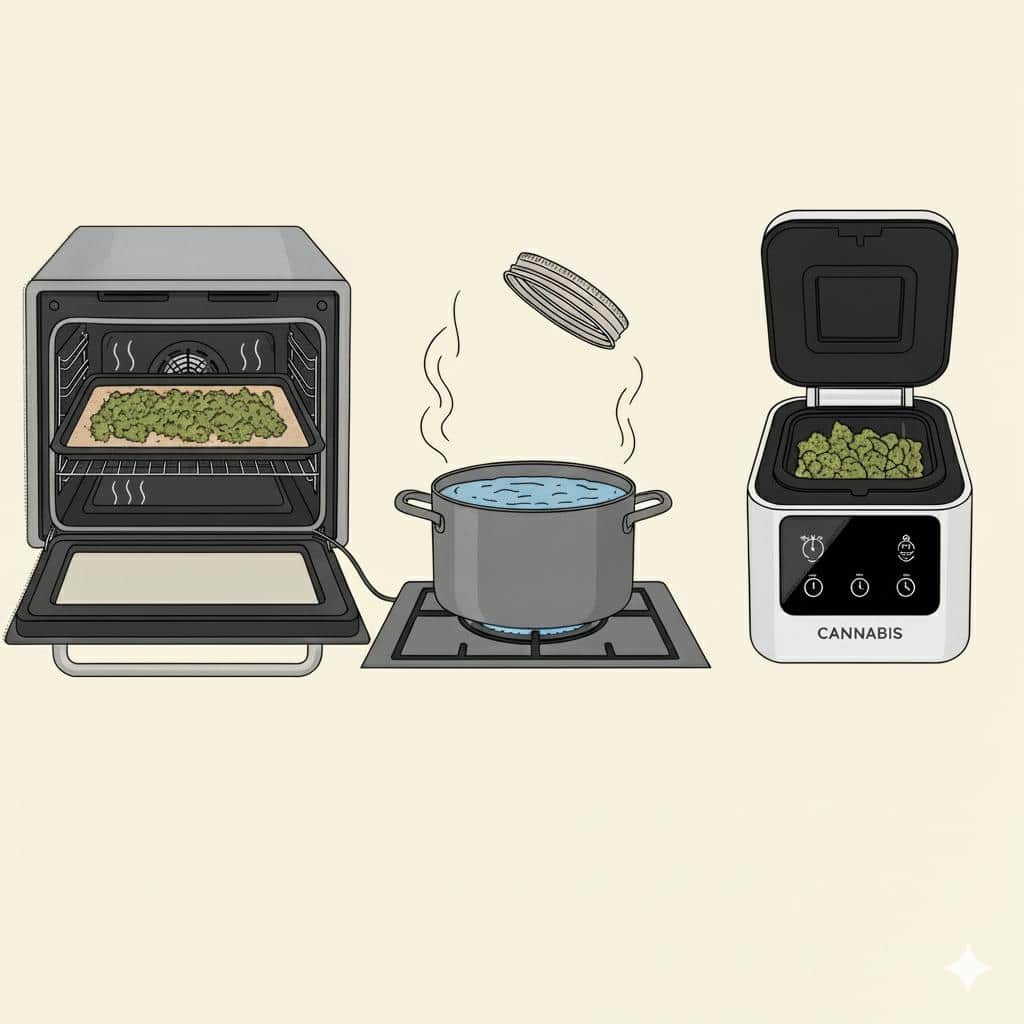
Heating cannabis material is an effective way to decarb it. Traditionally, cannabis is consumed through smoking the plant, which can instantly decarb the plant's oils. This can also be accomplished through vaporization of dry herb with a portable vape pen.
At home, there are many different ways users can decarboxylate cannabis, each requiring different steps and producing varying levels of smell.
Common ways to decarboxylate cannabis include:
- Oven on a baking sheet
- Oven in a mason jar
- Sous vide
- Decarboxylator, Ardent Nova, LEVO II)
- Natural decarb (light, heat, oxidation)
Here is an easy way to decarboxylate weed flower in an oven:
- Preheat the oven to 215º F.
- Place the ground cannabis in a baking dish covered with a see-through cover. Spread the buds evenly around.
- Place the baking dish in the oven when the desired temperature is reached.
- Bake the cannabis for about one hour and 20 minutes. Turn off the oven and remove the baking dish using an oven mitt.
- Allow the dish to cool for about 30 minutes before removing the cover.
6. Decarbed Weed Must Be Properly Stored
Using cannabis right after decarbing provides the best results, but with proper storage, decarbed weed can last for several months.
We recommend storing your decarbed weed in an airtight container in a cool, dark, and dry space.
Your cannabis can maintain a significant cannabinoid concentration for at least six months.
7. Decarbed Flower Can Make a Variety of Infusions
Once you have got your flower or extract material decarboxylated, you can use it for various purposes, including:
- Sublingual products
- Smoking
- Topicals
- Tinctures
- Edibles
Detailed Cannabinoid & Terpene Decarboxylation Profiles
Time and Temperature Charts
Different cannabinoids and terpenes activate or degrade at specific temperatures. A more technical approach includes:
| Compound | Target Temp | Result |
|---|---|---|
| THC (from THCA) | 220–240°F (105–115°C) for 30–40 min | Maximizes psychoactive potency |
| CBD (from CBDA) | 240–250°F (115–121°C) for 40–60 min | Maximizes therapeutic effects |
| CBN (from THC) | 250–275°F (121–135°C) for 60–90 min | Sedating effects from over-decarb |
| Myrcene (terpene) | Boiling ~167°F (75°C) | Preserved at lower temps, easily lost above 200°F |
| Limonene (terpene) | Boiling ~348°F (176°C) | More heat-resistant but still volatile |
Pro Tip:
If the goal is a relaxing, sedative edible, deliberately “over-decarb” THC at a higher temperature to encourage CBN formation. For uplifting effects, keep the temperature on the lower side and shorten the bake.
Decarboxylation of Concentrates & Extracts
Decarbing cannabis flower isn’t the same as decarbing extracts. Each form requires its own approach:
- Kief & Hash: Lower density than flower → use 220°F (105°C) for 20–25 min.
- Wax/Shatter: Place in a silicone container, heat 230°F (110°C) for 25–30 min.
- Rick Simpson Oil (RSO): Often pre-decarbed, but if raw, heat at 230°F (110°C) for 45 min.
- Distillates: Already decarbed in most cases, skip additional heat.
Always check product labeling; some concentrates come pre-activated.
Odor Control & Smell Mitigation
Decarbing flower or concentrates creates a strong smell that can linger. Tested strategies include:
- Jar Method: Break buds into a mason jar, seal loosely, bake at 220°F (105°C). Contains most odor.
- Sous Vide: Place cannabis in a vacuum-sealed bag, immerse in hot water bath (203°F / 95°C for ~90 min). Nearly odorless.
- Dedicated Decarb Devices: Products like the Ardent FX use sealed chambers with odor-control features.
Potency Calculation & Efficiency
Potency Formula
To estimate activated THC:
THC = (%THCA × 0.877) + (%THC)
- Example: A flower labeled 20% THCA will yield ~17.5% active THC after decarb.
Efficiency
- Home ovens reach about 80–90% conversion efficiency due to uneven heating.
- Specialized decarb devices claim 95–98% efficiency with lab-verified results.
Comparative Analysis of Decarb Devices
| Method | Cost | Ease of Use | Consistency | Odor | Efficiency |
|---|---|---|---|---|---|
| Oven | Free | Easy | Variable temps | Strong odor | 70–85% |
| Sous Vide | $100–200 | Moderate | Excellent temp control | Minimal odor | 80–90% |
| Ardent Nova/FX | $200–350 | Plug-and-play | Excellent | Minimal | 95–98% |
| LEVO II | $250+ | Multi-use (infuses + decarbs) | Excellent | Low | 95% |
Decarboxylation Frequently Asked Questions
Do I always need to decarb before making edibles?
Yes, unless using already-activated distillates or infused oils. Raw cannabis will not deliver noticeable effects.
Can I decarb too long?
Yes. Overheating past 300°F (149°C) degrades THC into CBN, reducing potency but increasing sedation.
How do I decarb without stinking up my kitchen?
Use the sous vide or jar method, or a sealed decarb device like the Ardent FX.
Is decarbing CBD different than THC?
Yes, CBD requires slightly higher heat and longer time (240–250°F for 45–60 minutes) compared to THC.
Can I decarb in a microwave?
No. Microwaves cause uneven heating and cannabinoid degradation.
How accurate are store-bought decarboxylators?
Independent lab tests show devices like Ardent or LEVO are highly consistent and outperform ovens in efficiency and terpene retention.
Learn How to Decarboxylate Weed at CTU
Learning how to decarboxylate weed the right way is a critical step in making the best cannabis infusions. Cannabis Training University’s online weed college provides students with world-class cannabis education.
Learn how to make edibles and infusions. Course topics include:
- How to cook cannabis
- How to make cannabis infusions
- How to extract cannabis
- And so much more!
Enroll in the most renowned marijuana industry training program today!

Karen Getchell
Karen gained expertise in developing training programs and technical documentation as a Senior Editor at Cisco Systems. She began her journey in cannabis as a patient, searching for a way to heal herself. When she perfected a method for making cannabis oil, other patients began to seek her out. An early adopter of CBD medicine, she started her CBD-infused-products business in 2014. Over the last two decades, Karen has taught hundreds of patients and caregivers how to select strains, infuse oils, and extract cannabinoids.
When she isn’t teaching cannabis cooking classes, Karen works as a cannabis business consultant, writes for online cannabis publications like Cannabis Training University, Leafly, and Weedmaps, and runs a CBD-infused-product business.



 Jeff was involved in an accident where he endured a traumatic brain injury. He had a week-long stay in ICU where brain surgeons
  100% risk free money back guarantee within 48 hours after purchase if student has not completed any of the courses or exams.
