One of the most common cannabis-related questions in 2025 is, how long does weed stay in your system? The THC detection times can vary greatly depending on many different factors.
Whether you’re preparing for a workplace drug test, curious about cannabis metabolism, or simply want to understand how THC (the chemical known as tetrahydrocannabinol) interacts with your body, the answer is not always straightforward.
The truth is, weed can stay in your system anywhere from a few hours to over 90 days, depending on factors like frequency of use, body composition, test type, and potency. Unlike alcohol, which is water-soluble and clears relatively quickly, THC is fat-soluble.
That means it can remain stored in your body fat long after the high is gone.
This guide will break down everything you need to know in detail, including:
Cannabis detection is more than just a simple yes-or-no answer—it’s a nuanced process shaped by how long weed stays in your system and the type of drug test being used.
The length of time cannabis remains in your system depends on several factors, such as how often you use it, your body fat percentage, and the specific test administered.
For instance, someone with a higher body fat percentage may retain THC metabolites longer, as these compounds are stored in fat cells.
Drug tests are designed to detect cannabis in various ways. THC Hair tests can reveal cannabis use for up to 90 days after the last use, making them one of the longest detection windows available.
Blood tests, on the other hand, typically detect cannabis for a much shorter period, often just a few days.
Urine tests are the most common and can detect cannabis for up to 30 days, especially in frequent users.
Saliva tests are used for more immediate detection, usually within a few days of use. Ultimately, how long weed stays in your system and remains detectable via drug testing depends on your frequency of use, your body’s composition, and the type of test you’re facing.
Cannabis detectability refers to how long cannabis and its metabolites can be identified in your body through drug testing. The length of time weed stays in your system and remains detectable is influenced by several key factors, making the process highly individual.
One of the most significant variables is the type of drug test being used—urine, blood, saliva, or hair tests each have different detection capabilities and timeframes.
Another major factor is the frequency of use. Occasional users may find that cannabis is only detectable for a few days after the last use, while chronic or daily users can have THC metabolites remain in their system for weeks or even months.
This is because repeated exposure leads to a buildup of metabolites in the body, making it harder to eliminate them quickly.
Individual characteristics, such as body mass index (BMI), also play a crucial role in cannabis detectability. Since THC and its metabolites are stored in fatty tissues, people with a higher body mass index may retain these compounds longer, resulting in extended detection windows during drug testing.
This means that two people with different BMIs but similar usage patterns could have very different outcomes on a drug test.
Ultimately, how long cannabis stays in your system and is detectable via drug testing depends on a combination of your personal physiology, how often you use cannabis, and the specific test being administered.
Understanding these factors can help you better anticipate detection times and prepare for any required drug tests.
When you smoke, vape, or eat cannabis, THC enters your bloodstream. The cannabis plant is a source of a chemical, specifically THC, which is responsible for its psychoactive effects. After entering the bloodstream, the body breaks down THC primarily in the liver, where it is metabolized and stored in fatty tissues.
The body processes THC through absorption into the bloodstream, metabolism in the liver, storage in fat cells, and eventual elimination through urine or stool.
The body breaks down THC into 11-hydroxy-THC (active, especially in edibles) and eventually into 11-nor-9-carboxy-THC (THC-COOH), the non-psychoactive metabolite that drug tests detect. How long does it take for the body to metabolize and eliminate THC?
This duration varies depending on individual factors such as metabolism, frequency of use, and body fat percentage.
Because THC metabolites are lipophilic (fat-soluble), they bind to fat molecules and fat cells in the body and release slowly over time. This is why cannabis stays in your system much longer than other substances. The half-life of THC metabolites varies, ranging from 1–2 days in light users to up to 10 days in chronic heavy users.
The detection window for THC in the body depends on a number of factors including frequency of use, body composition, and the type of test administered.
How long THC and its metabolites remain detectable after someone has taken the drug varies, as metabolites can stay in the system for different periods depending on these factors.

Drug tests are specifically designed to identify THC and its metabolites in your body. THC, or tetrahydrocannabinol, is the main psychoactive ingredient in cannabis, and when you smoke, ingest, or vape weed, THC enters your bloodstream and is processed by your body.
As your system breaks down THC, it creates metabolites that are stored in fatty tissues, especially if you have a higher body mass index (BMI).
These metabolites can linger in your system long after the effects of cannabis have worn off. In fact, metabolites of THC remain in the body and can be detected long after use.
Different types of drug tests—such as urine testing, blood tests, and hair tests—are used to detect these metabolites. Urine testing is the most common method for detecting cannabis use, as it can identify THC and its metabolites for days or even weeks after use, depending on how often you consume cannabis.
Blood tests are more likely to detect recent use, while hair tests can reveal a much longer history of cannabis consumption. The frequency of use and your individual body composition, including your BMI, play a significant role in how long these metabolites remain in your system and are detectable via drug testing.
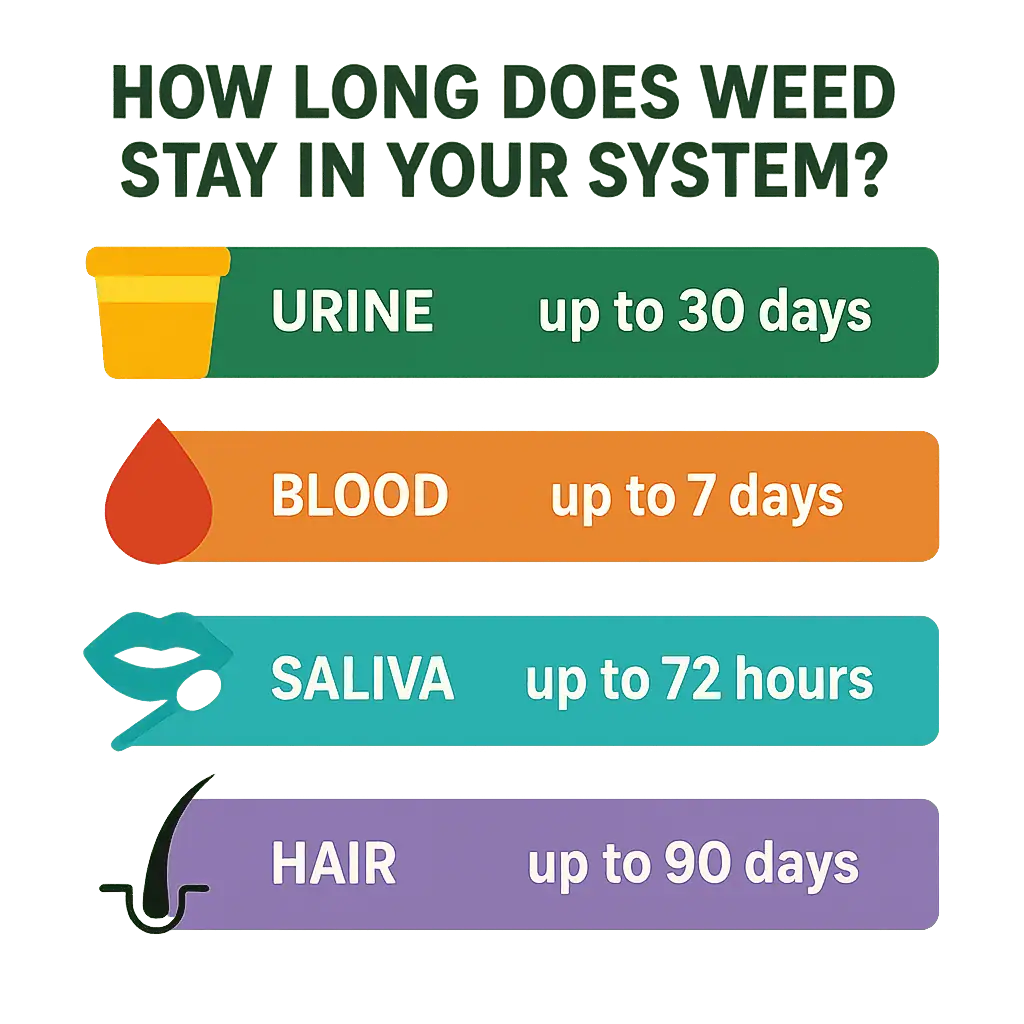
When considering how long does weed marijuana stay in your system, it’s important to know that detection times vary depending on the type of drug test used.
Cannabis and its metabolites can be detected in your system for different periods, depending on whether the test is blood, urine, saliva, or hair-based.
Overview:
How long is cannabis detectable in your body depends on the testing method. Blood tests can detect recent use, while urine tests are commonly used to detect marijuana for days or weeks after use.
Saliva tests are effective for short-term detection, and hair follicle tests can identify cannabis use over a much longer period, sometimes up to 90 days and hair follicles can retain evidence of use for months.
Cannabis is detectable via drug testing for varying periods, so the method chosen impacts the detection window.
Blood Test:
THC is typically detectable in blood for up to 12–24 hours after use, but in some cases, it may be present for several days, especially in frequent users.
Urine Test:
Urine tests are the most common way to detect marijuana use. THC metabolites can be detected in your system for up to 3–30 days after last use, depending on frequency and individual metabolism.
Saliva Test:
Saliva tests can detect cannabis for up to 24–72 hours after use, making them useful for identifying recent consumption.
Hair Test:
Hair follicle tests can detect cannabis use for up to 90 days and hair follicles retain THC metabolites for an extended period, making this method effective for identifying long-term use.
The most common cannabis drug test. Detects metabolites, not active THC.
Detect active THC and metabolites.
Detect recent cannabis use. Popular for roadside or workplace spot checks.
Detect long-term history of cannabis use.
Detect very recent cannabis use.
Case 1: Olivia (Occasional Smoker)
Case 2: Marcus (Daily Edible User)
Case 3: Hannah (Fitness Enthusiast, Regular Vaper)
Case 4: Jason (Chronic Heavy Smoker)
“In my clinical experience, detection times vary dramatically. I’ve seen light users test negative after 3 days and heavy users still test positive after 8 weeks.” – Substance Abuse Counselor
“I was shocked to fail a urine test after 4 weeks. I thought a month was enough, but I learned my body stores THC longer.” – Daily Cannabis Consumer
“As a former athlete, hydration and cardio helped me clear tests faster than friends who were sedentary and more likely to test positive.” – Recreational User
While time and abstinence are the only guaranteed methods, some strategies may support natural clearance:
Keep in mind that chronic cannabis use can make it significantly more difficult to eliminate THC metabolites quickly, as ongoing use leads to accumulation in the body over time.
If you know a drug test is coming up, understanding how long weed stays in your system is crucial for minimizing your risk of testing positive. For occasional users, THC metabolites may only be detectable in urine for a few days, but for chronic users, these compounds can remain in your system for up to 30 days or more.
Employers often require drug tests as part of the hiring process, so it’s important to be aware of the detection window for each type of test—whether it’s a urine test, blood test, or hair test.
To prepare for a drug test, the most effective strategy is to abstain from cannabis use for as long as possible before the test. While some products claim to mask or eliminate THC metabolites, they are not guaranteed to work and may not prevent detection.
Chronic users, in particular, may find that THC remains in their system much longer than expected.
Understanding your own usage patterns and the type of test you’ll be taking can help you make informed decisions and reduce the likelihood of a positive result. Remember, the only surefire way to pass a drug test is to allow enough time for your body to naturally eliminate THC metabolites.
For occasional users, 3–7 days. For heavy users, 30–60+ days. Marijuana use can be detected in urine, blood, saliva, and hair, with detection windows varying by sample type and usage patterns.
Yes. Edibles produce more metabolites due to liver processing, often leading to longer detection. THC enters the body when someone smokes, ingests or vapes cannabis, and the method of use can impact how long it stays detectable.
Time is the most reliable. Hydration, exercise, and diet may help, but nothing clears THC instantly.
Extremely rare under normal conditions, but prolonged exposure in an enclosed space may show trace levels. However, exposure to cannabis could potentially lead to a positive test result in rare cases.
THC-COOH half-life is ~1–2 days in light users, 5–10 days in heavy users. THC, known as tetrahydrocannabinol (THC), is the main psychoactive compound in marijuana.
They may dilute urine temporarily but are not foolproof. Some labs flag overly diluted samples.
Up to 90 days, depending on hair length tested.
THC, known as tetrahydrocannabinol (THC), which produces the psychoactive effects, is the active chemical in cannabis responsible for the ‘high’ when someone smokes, ingests or vapes marijuana.
Yes, many employers require drug tests as part of their hiring or employment process. Understanding detection windows for marijuana use is important for workplace compliance.
Test Type | Occasional User | Moderate User | Daily User | Heavy User |
|---|---|---|---|---|
Urine | 3–7 days | 7–14 days | 10–30 days | 30–60+ days |
Blood | 1–2 days | 3–7 days | 7–14 days | 25+ days |
Saliva | 1–3 days | 3–7 days | 7–10 days | 10–29 days |
Hair | Up to 90 days | Up to 90 days | Up to 90 days | Up to 90 days |
Marijuana use disorder is characterized by an inability to stop using the drug despite negative consequences in various aspects of life.
So, how long does weed stay in your system? The answer depends on many factors, but the general ranges are:
For chronic cannabis users, detection times can be significantly longer, as the body processes and stores THC metabolites from prolonged or habitual use, resulting in lasting effects and extended detection windows.
The bottom line: time is the only guaranteed solution. Staying hydrated, exercising, and eating clean may help, but your body needs time to fully eliminate THC metabolites.
Whether you’re a medical patient, recreational user, or someone preparing for an upcoming test, understanding how long does weed stay in your system based on your usage patterns and the type of test will help you plan responsibly and avoid surprises.
Learn much more in our medical marijuana certification courses online.
More in Medical cannabis

Check your state's cannabis laws

Medical cannabis, CBD, patient-focused education
 IACET Accredited Provider · online cannabis education
Since 2009 • 50,000+ students trained worldwide



Copyright Cannabis Training University, a subsidiary of Online Training Providers. © 2026. All Rights Reserved.
Medical Disclaimer: The information on this website is for informational purposes only and is not intended to be a substitute for professional medical advice, diagnosis, or treatment.
Always seek the advice of a physician or other qualified health provider with any questions you may have regarding a medical condition.
Legal Compliance: Cannabis remains federally illegal. Products and information are intended only for jurisdictions where cannabis use and possession is legal.
By using this site, you affirm that you are of legal age (21+) and responsible for understanding your local laws.