SALEFall Sale: All 7 courses for the price of one. Master of Cannabis $199 (reg. $399). Ends Sunday at midnight ET.Fall Sale: all 7 courses $199 (reg. $399). Ends Sun midnight ET.

Cannabis Plant Problems: A Photo Guide to Pests, Diseases and Deficiencies

Reviewed by Jeff Zorn, founder of Cannabis Training University (since 2009, 50,000+ students) · LinkedIn

About Jeff

Jeff Zorn is the founder of Cannabis Training University (CTU), an online cannabis school with 50,000+ students since 2009. CTU is an IACET Accredited Provider, and its courses cover cannabis cultivation, business, medical cannabis, budtending, cooking, extraction and industry regulations.

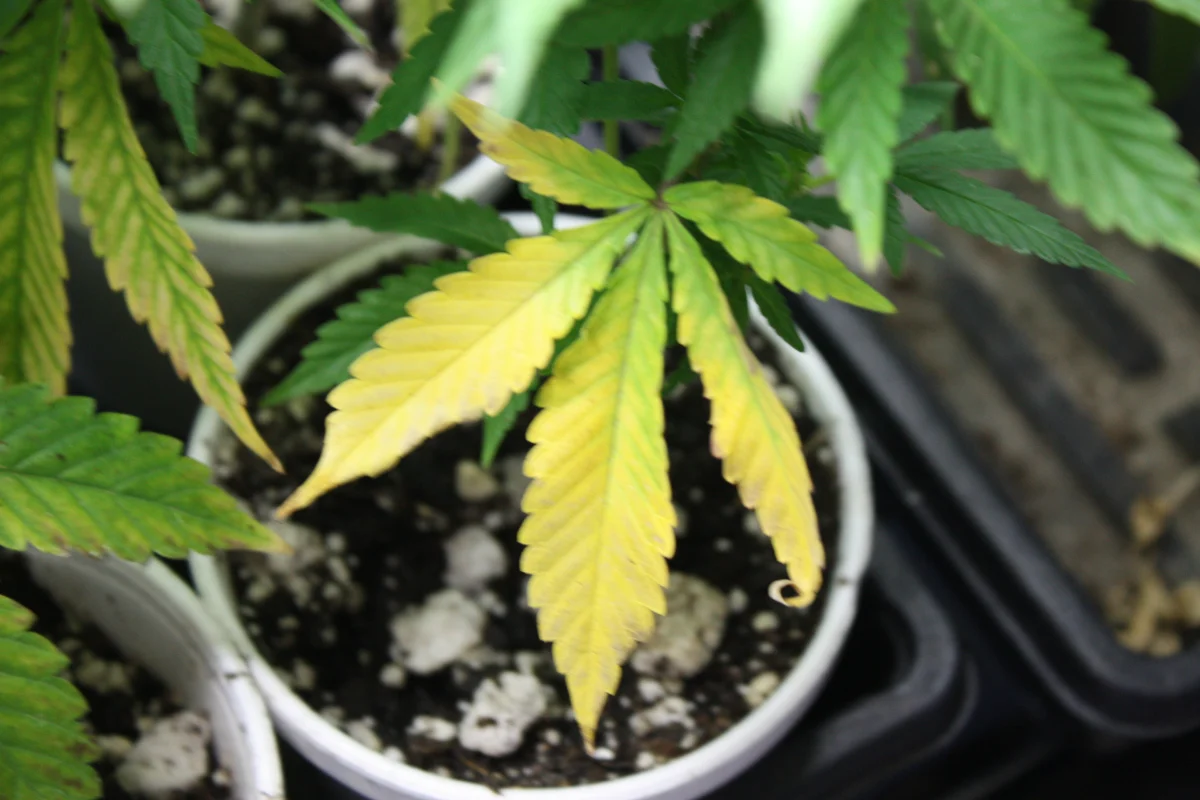
Young potted cannabis plant with yellowing fan leaves

Eleven problems that show up most in cannabis grows, with real photos, what growers see, the usual causes and what to check first. Start with the symptom you see on your plant.

Updated Oct 27, 202611 problemsSourcesPhoto credits

Plant-growing information only. Many problems look alike, and two can happen at once; confirm with a hand lens, your feed and pH readings, or your local extension office before you act. Any pest or disease control product you use must be legal for use on cannabis in your state[16].

Pests

01

Fungus gnats

Bradysia spp.

Small dark flies that breed in constantly wet growing media. The adults are a nuisance; the larvae feed on roots and can slow seedlings and clones.

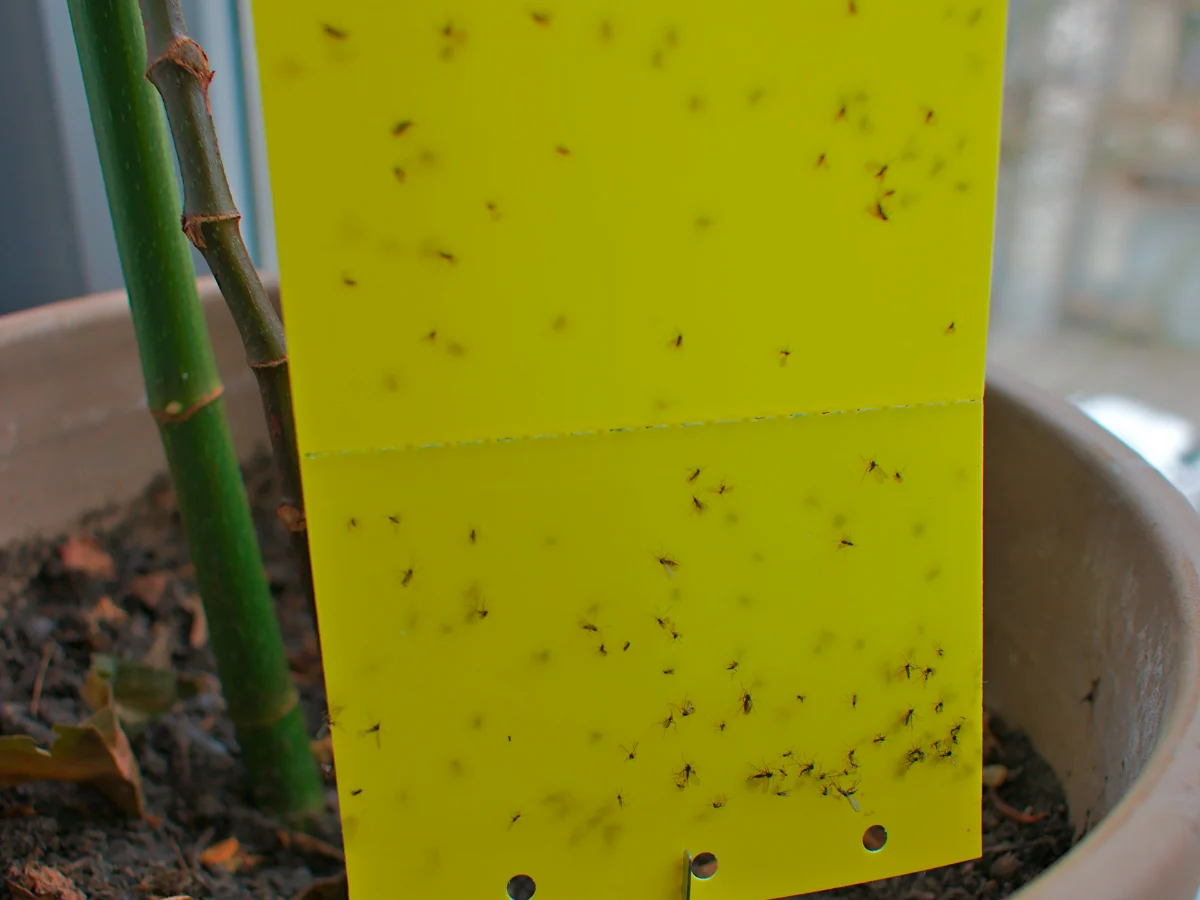
Yellow sticky card in a potted plant, covered with small dark fungus gnats
Yellow sticky card covered in fungus gnats, in a houseplant pot (not cannabis).Photo: User:Ich, Wikimedia Commons, CC BY-SA 4.0 (cropped)
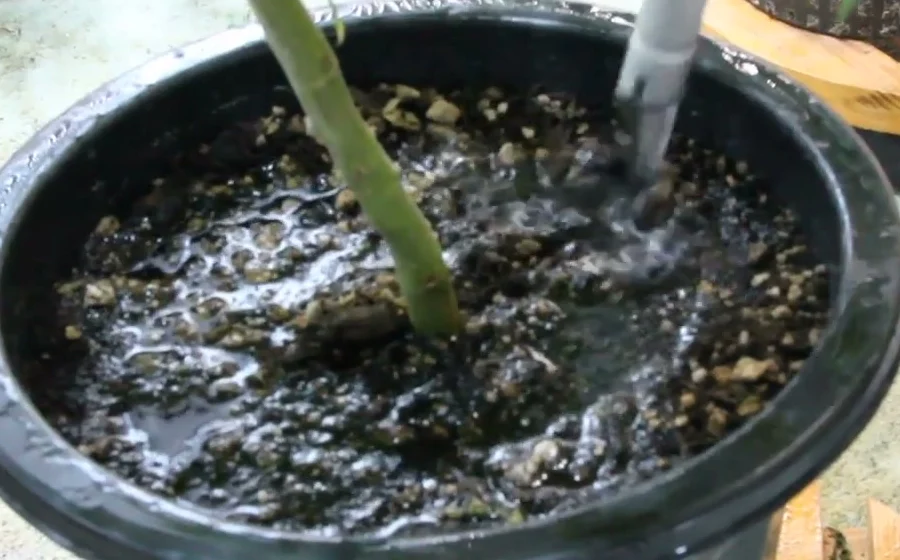
Water pooling on dark, saturated topsoil in a black pot around a young cannabis stem
Constantly wet topsoil is where larvae breed.Photo: Cannabis Training University (frame from CTU course video, cropped)
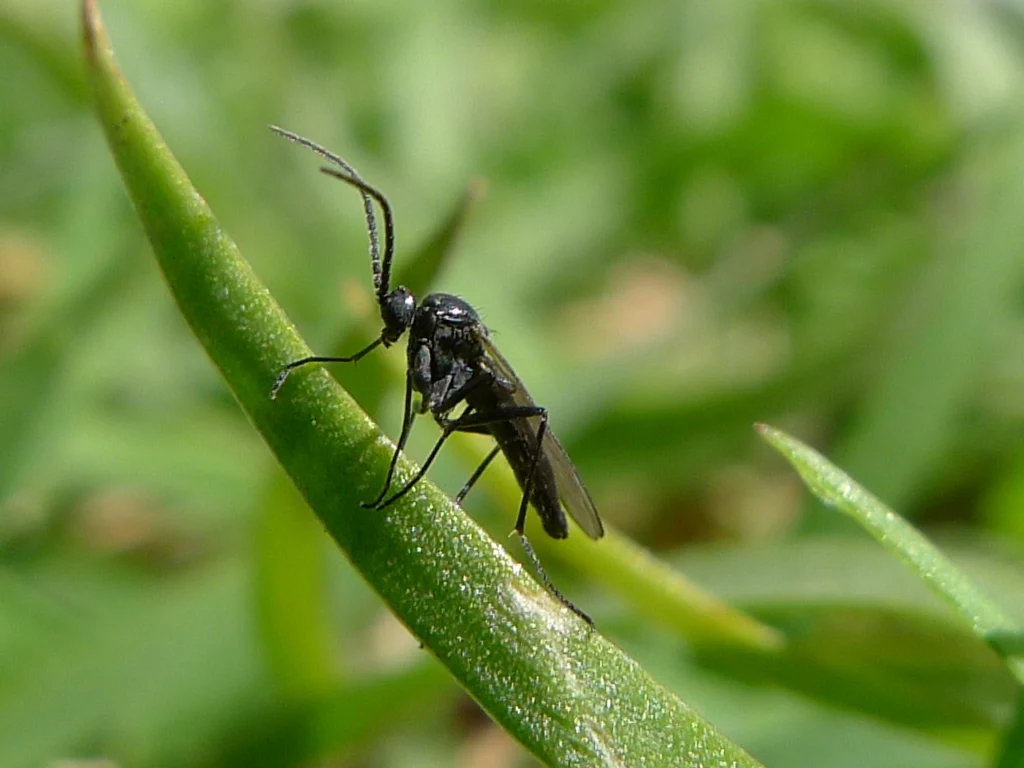
Side view of an adult dark-winged fungus gnat with long legs and antennae
Adult fungus gnat on a grass blade, not cannabis.Photo: John Tann, Wikimedia Commons, CC BY 2.0 (cropped)

What growers see

  • Small, dark, long-legged flies walking on the soil surface or flying up when you water or move the pot.[1]
  • Clear-bodied larvae with shiny black heads in the top inch or two of moist media; slime trails on very wet surfaces.[1]
  • Seedlings and fresh clones that stall, wilt or yellow when larvae numbers are high.

Likely causes

  • Media that stays wet between waterings, poor drainage and standing water in saucers.[1]
  • Organic, peat- or compost-rich mixes and algae on the surface.[1]

What to check first

  • Let the surface of the media dry between waterings; empty saucers and improve drainage.[1]
  • Hang yellow sticky cards just above the pots and count adults each week.[1]
  • Press cut potato chunks, cut side down, into the media for a few days, then look for larvae underneath.[1]

On CTUFungus gnats on marijuanaOverwatered plants

02

Spider mites

Two-spotted spider mite, Tetranychus urticae

Tiny mites that feed on the undersides of leaves; one of the main pests of indoor and greenhouse cannabis.

Cannabis fan leaf speckled pale from spider mite feeding, with fine webbing
Stippling and webbing on a cannabis fan leaf.Photo: Rikva, Wikimedia Commons, Public domain

What growers see

  • Fine pale dots (stippling) on the upper side of leaves that merge into dull, bronzed patches.[2]
  • Fine webbing between leaves, stems and buds once numbers build up.[2]
  • Moving specks and round eggs on leaf undersides, seen with a hand lens.[2]

Likely causes

  • Hot, dusty conditions and water-stressed plants.[2]
  • Mites carried in on clones, other plants, clothing or tools; indoor crops keep populations going year-round.[3]

What to check first

  • Check leaf undersides with a hand lens, starting with the lowest and oldest leaves.[2]
  • Tap a branch over white paper and watch for specks that move.
  • Inspect and isolate new clones and plants before they join the room; remove badly infested leaves.[3]

On CTUSpider mites on marijuanaCommon pests and diseases

03

Hemp russet mites

Aculops cannabicola

Microscopic mites that live only on cannabis and hemp. They are far smaller than spider mites, so the damage is usually seen long before the mites are.

What growers see

  • Leaves that turn dull, grayish, bronzed or rusty (“russeted”).[3][4][5]
  • A slight upward roll of leaf edges in some cultivars; not every plant curls.[3][4]
  • No visible mites: you need at least 15–20x magnification, and a microscope to confirm.[4][5]

Likely causes

  • Infested clones and cuttings; continuous cloning keeps populations going.[3][4]
  • Greenhouses and indoor rooms with a steady supply of new plants, where the mite survives year-round.[5]

What to check first

  • Inspect cuttings and the mother plant under magnification before cloning.[4][5]
  • Isolate new plants and clones until they have been checked.[5]
  • Ask your extension office to confirm a suspected case under a microscope.[5]

On CTUCommon pests and diseases

04

Thrips

Order Thysanoptera, incl. western flower thrips

Slender, fast-moving insects about the size of a comma that rasp leaf surfaces and suck out the contents.

Magnified slender pale thrips adult on a small white and red rattlesnake sandmat flower
Thrips adult (probably western flower thrips) on a rattlesnake sandmat (Euphorbia) flower, not cannabis.Photo: Dave Kirkeby, Wikimedia Commons, CC BY-SA 4.0 (cropped)
Pepper flower held between two fingers with several small thrips on the petals and center
Adult thrips on a pepper flower, not cannabis.Photo: Metin GÜLEŞCİ, Wikimedia Commons, CC BY 4.0 (cropped)

What growers see

  • Silvery or bronzed, scarred patches and fine stippling on leaves.[6]
  • Tiny black, varnish-like specks (thrips droppings) on the damaged areas.[6]
  • Slender pale or dark insects in leaf folds and along veins.[6]

Likely causes

  • Thrips arriving on new plants or flying in from outdoors and nearby weeds.[6]

What to check first

  • Hang blue or bright yellow sticky cards to detect flying adults.[6]
  • Shake a branch over white paper and look for slender insects.[6]
  • Remove weeds and old plant debris near the grow.[6]

On CTUCommon pests and diseases

Diseases

05

Bud rot

Gray mold, Botrytis cinerea

A gray mold that rots flowers from the inside, often before the outside of the bud shows it.

Cannabis cola destroyed by bud rot: brown, dead, curled leaves and bracts in a greenhouse
Advanced bud rot: the whole cola is brown and dead.Photo: Punja et al. 2019, Front. Plant Sci. 10:1120 (Fig. 4B, cropped). CC BY 4.0
Developing cannabis bud with brown, decaying leaves and bracts from early bud rot
Early infection: browning leaves and bracts.Photo: Punja et al. 2019, Front. Plant Sci. 10:1120 (Fig. 4A, cropped). CC BY 4.0
Two harvested cannabis buds, one green and one brown and decayed with mold inside
Harvested buds: decay and mold inside.Photo: Punja et al. 2019, Front. Plant Sci. 10:1120 (Fig. 4D, cropped). CC BY 4.0

What growers see

  • A few sugar leaves sticking out of a cola turn yellow or brown and wilt while the rest of the plant looks healthy.[7]
  • Brown, decaying tissue inside the bud, then gray, fuzzy mold; whole colas can be destroyed.[7]
  • Brown spots on nearby leaves where spores from rotting buds have landed.[7]

Likely causes

  • High humidity and poor air flow, especially in large, dense colas late in flowering.[8]
  • Spores spreading from infected buds to leaves and other plants.[7]

What to check first

  • Look inside the densest colas every day in late flower; check where leaves meet the bud.
  • Bring humidity down and improve air movement through the canopy.[8]
  • Cut out infected buds well below the rot and bag them before carrying them out of the room.

On CTUMold on weedCommon pests and diseases

06

Powdery mildew

Golovinomyces spp.

White, flour-like fungal growth on leaves, stems and buds. Common in indoor and greenhouse grows.

Cannabis fan leaf covered in white, powdery patches of mildew
Advanced powdery mildew on a fan leaf.Photo: Punja et al. 2019, Front. Plant Sci. 10:1120 (Fig. 7B, cropped). CC BY 4.0
Young cannabis leaf with sparse, faint white mildew spots
Early, sparse white spots.Photo: Punja et al. 2019, Front. Plant Sci. 10:1120 (Fig. 7A, cropped). CC BY 4.0
Cannabis flower top with leaves dusted white by powdery mildew
Mildew on a flowering top.Photo: Punja et al. 2019, Front. Plant Sci. 10:1120 (Fig. 7D, cropped). CC BY 4.0

What growers see

  • Small, sparse white spots on the upper side of young leaves.[7]
  • Spots that spread until leaves look dusted with flour, then stems and buds too.[7]

Likely causes

  • Spores that move on air currents and on infected clones; widespread in greenhouses.[7][8]
  • Crowded plants, poor air circulation and humid air around the leaves.[9]

What to check first

  • Check lower and inner leaves, and every new clone, for white spots.[7]
  • Space plants for air circulation and keep water off the leaves.[9]
  • Remove and bag badly affected leaves.

On CTUPowdery mildew on cannabisMold on weed

07

Root rot

Pythium and Fusarium spp.

Water molds and fungi that brown and decay roots and crowns, so the plant cannot take up water even when it is wet.

Plant pulled from a hydroponic net pot showing a brown, rotted root mass
Brown, rotted roots on a hydroponic chickpea plant, not cannabis.Photo: Bjornwireen, Wikimedia Commons, CC BY-SA 3.0 (cropped)
Two young cannabis plants side by side: a healthy one and a smaller, yellowing one with Fusarium
Healthy plant (left) vs. Fusarium-infected plant (right).Photo: Punja et al. 2019, Front. Plant Sci. 10:1120 (Fig. 2H, cropped). CC BY 4.0
Cannabis stem cut lengthwise showing brown discolored pith at the crown
Brown pith inside the crown.Photo: Punja et al. 2019, Front. Plant Sci. 10:1120 (Fig. 2I, cropped). CC BY 4.0

What growers see

  • Stunted plants with yellowing leaves next to healthy ones of the same age.[7]
  • Roots that are brown and decayed instead of white; in hydro, slimy brown roots.[7][10]
  • Brown discoloration inside the stem at the crown; cuttings that collapse at the base.[7]

Likely causes

  • Overwatering, high fertility and media that stay wet.[11]
  • Warm, low-oxygen nutrient solution in hydro systems.[10]
  • Spores carried in recirculated nutrient solution, water and dirty equipment.[7][10]

What to check first

  • Pull a plant and look at the roots: healthy roots are white and firm.[10]
  • Avoid overwatering and overfeeding; keep hydro root zones at about 68–72°F with good aeration.[10][11]
  • Clean and disinfect trays, reservoirs and tools between crops.[10][11]

On CTUCannabis root diseaseOverwatered plants

Nutrient problems

08

Nitrogen deficiency

The most common deficiency. Nitrogen moves out of old leaves to feed new growth, so the bottom of the plant shows it first.

Potted cannabis plant with yellow and brown lower leaves from advanced nitrogen deficiency
Advanced: lower leaves yellow, brown and dropping.Photo: Cockson et al. 2019, Appl. Sci. 9:4432 (Fig. 2, N advanced, cropped). CC BY 4.0
Cannabis plant with pale yellow-green lower leaves from nitrogen deficiency
Intermediate: lower leaves pale yellow.Photo: Cockson et al. 2019, Appl. Sci. 9:4432 (Fig. 2, N intermediate, cropped). CC BY 4.0

What growers see

  • Lower, older leaves turn pale, then yellow, starting at the bottom of the plant.[12]
  • Yellowing that moves up to the middle leaves; badly affected leaves brown and drop.[12]
  • Slower, smaller plants overall.[15]

Likely causes

  • Too little nitrogen in the feed, or media that has been leached out.[12][15]
  • Root-zone pH outside the normal range, which changes what roots can take up.[13]

What to check first

  • Check your feed recipe and EC against the stage of growth.
  • Measure the pH of what goes in and what runs off.[13]
  • Remember some lower-leaf yellowing late in flowering is normal.

On CTUNutrient deficiency chartCommon deficiencies

09

Calcium deficiency

Calcium does not move within the plant, so new growth at the top shows the damage first.

Cannabis top with distorted, twisted new leaves and brown edges from calcium deficiency
Advanced: twisted new growth with brown edges.Photo: Cockson et al. 2019, Appl. Sci. 9:4432 (Fig. 2, Ca advanced, cropped). CC BY 4.0
Cannabis growing tip with stunted, curled new leaves from calcium deficiency
Intermediate: stunted, irregular growing tip.Photo: Cockson et al. 2019, Appl. Sci. 9:4432 (Fig. 2, Ca intermediate, cropped). CC BY 4.0

What growers see

  • Stunted, irregular growing tips and newly expanding leaves.[12]
  • Later, yellowing between the veins and brown, dead edges on new leaves.[12]

Likely causes

  • Too little calcium in the feed; soft or reverse-osmosis water supplies little of it.
  • Root-zone pH outside the normal range.[13]

What to check first

  • Check that your nutrient line supplies calcium, especially with RO water or coco.
  • Measure input and runoff pH.[13]

On CTUNutrient deficiency chartCommon deficiencies

10

Magnesium deficiency

Magnesium is mobile, so the lower, older leaves yellow between the veins while the veins stay green.

Cannabis fan leaf turned yellow between green veins from magnesium deficiency
Advanced: a lower leaf yellow between the veins.Photo: Cockson et al. 2019, Appl. Sci. 9:4432 (Fig. 3, Mg advanced, cropped). CC BY 4.0
Cannabis leaves with early yellowing between the veins
Intermediate: interveinal yellowing begins.Photo: Cockson et al. 2019, Appl. Sci. 9:4432 (Fig. 3, Mg intermediate, cropped). CC BY 4.0

What growers see

  • Slight yellowing between the veins of lower, older leaves.[12]
  • Yellowing that spreads until the whole leaf is pale yellow, starting around the midrib and leaflet bases.[12]

Likely causes

  • Too little magnesium in the feed.[12]
  • Root-zone pH outside the normal range.[13]

What to check first

  • Check that your feed includes magnesium at the label rate for the stage.
  • Measure input and runoff pH.[13]

On CTUNutrient deficiency chartCommon deficiencies

11

Nutrient burn

Too much fertilizer (high EC)

Feeding too strong builds up salts in the root zone. Tips and edges of leaves burn first; too much nitrogen also makes leaves very dark.

Very dark green cannabis leaf from a plant fed excess nitrogen
Too much nitrogen: a very dark green leaf (320 mg/L N).Photo: Saloner & Bernstein 2020, Front. Plant Sci. 11:572293 (Fig. 1, 320 mg/L N leaf, cropped). CC BY 4.0

What growers see

  • Yellow, then brown, crisp leaf tips and margins (marginal burn).[14]
  • Very dark green, smaller leaves and slower growth when nitrogen is too high.[15]
  • Wilting even when the media is wet, from salt injury to roots.[14]

Likely causes

  • Fertilizer mixed stronger than the plant needs (high EC).[14][15]
  • Salts building up in the media between waterings.[14]

What to check first

  • Measure the EC of your feed and of the runoff, and compare them.[14]
  • Feed at or below the label rate; water thoroughly so some runs out of the pot.[14]

On CTUNutrient deficiency chartOverwatered plants

Learn to prevent problems, not just treat them

The Cannabis Growing course covers pests, diseases and plant nutrition alongside every stage of the grow, from seed to cured harvest.

See the Growing courseTry the first lesson free

Sources

  1. Bethke, J.A. & Dreistadt, S.H. (updated Aug 2013). “Fungus Gnats.” Pest Notes, UC ANR Publication 7448. UC Statewide IPM Program. ipm.ucanr.edu/home-and-landscape/fungus-gnats
  2. Godfrey, L.D. (updated Dec 2011). “Spider Mites.” Pest Notes, UC ANR Publication 7405. UC Statewide IPM Program. ipm.ucanr.edu/home-and-landscape/spider-mites
  3. Cranshaw, W., Schreiner, M., Britt, K., Kuhar, T.P., McPartland, J. & Grant, J. (Aug 28, 2019). “Developing Insect Pest Management Systems for Hemp in the United States: A Work in Progress.” Journal of Integrated Pest Management 10(1): 26. doi.org/10.1093/jipm/pmz023
  4. Colorado State University, Department of Agricultural Biology (2022). “Hemp russet mite.” agsci.colostate.edu/agbio/ipm-pests/29895-2
  5. Pulkoski, M. & Burrack, H. (Aug 4, 2020). “Hemp Russet Mite in Industrial Hemp.” NC State Extension. content.ces.ncsu.edu/hemp-russet-mite-in-industrial-hemp
  6. Bethke, J.A., Dreistadt, S.H. & Varela, L.G. (updated May 2014). “Thrips.” Pest Notes, UC ANR Publication 7429. UC Statewide IPM Program. ipm.ucanr.edu/home-and-landscape/thrips
  7. Punja, Z.K., Collyer, D., Scott, C., Lung, S., Holmes, J. & Sutton, D. (Oct 17, 2019). “Pathogens and Molds Affecting Production and Quality of Cannabis sativa L.” Frontiers in Plant Science 10: 1120. doi.org/10.3389/fpls.2019.01120
  8. Bergstrom, G., Starr, J. & Myers, K. (revised Aug 2020). “Diseases Affecting Hemp in New York.” Cornell University, College of Agriculture and Life Sciences. hemp.cals.cornell.edu (PDF)
  9. Utah State University Extension, Integrated Pest Management. “Powdery Mildew (hemp).” extension.usu.edu/planthealth/ipm/notes_ag/hemp-powdery-mildew
  10. Colorado State University Extension, PlantTalk Colorado. “2043: Root Disease Problems & Management in Hydroponic Systems.” planttalk.colostate.edu
  11. Wick, R.L., updated by Madeiras, A. (Oct 3, 2019). “Root Diseases of Greenhouse Crops.” UMass Extension Greenhouse Crops & Floriculture. umass.edu
  12. Cockson, P., Landis, H., Smith, T., Hicks, K. & Whipker, B.E. (Oct 18, 2019). “Characterization of Nutrient Disorders of Cannabis sativa.” Applied Sciences 9(20): 4432. NC State University. doi.org/10.3390/app9204432
  13. Currey, C.J. (Feb 2022). “Managing micronutrients in hydroponic culture.” e-GRO Edible Alert 7(4). Iowa State University. e-GRO (PDF)
  14. UMass Extension Greenhouse Crops & Floriculture (updated Oct 27, 2016). “Soluble Salts and Electrical Conductivity (EC) for Greenhouse Crops.” umass.edu
  15. Saloner, A. & Bernstein, N. (Nov 17, 2020). “Response of Medical Cannabis (Cannabis sativa L.) to Nitrogen Supply Under Long Photoperiod.” Frontiers in Plant Science 11: 572293. doi.org/10.3389/fpls.2020.572293
  16. Oregon Department of Agriculture, Oregon Health Authority & Oregon Liquor Control Commission (Nov 21, 2016). “Dear Cannabis Producer” letter on pesticide use. oregon.gov (PDF)
  17. Minnesota Department of Agriculture. “Registered Pesticides for Use on Hemp.” mda.state.mn.us/registered-pesticides-use-hemp

Sources checked Oct 27, 2026. This page makes no health claims. Grow only where home cultivation is legal for you.

Photo credits

Every photo is a real photograph. Figures from open-access papers and Wikimedia Commons are used under the licence shown under each photo and were cropped to remove panel letters, labels and scale bars. CTU photos are frames from CTU course video.

Jeffrey (Jeff) Zorn-CEO Cannabis Training University picture

Jeff Zorn

Jeff Zorn is the founder of Cannabis Training University (CTU), an online cannabis school with 50,000+ students since 2009. CTU is an IACET Accredited Provider, and its courses cover cannabis cultivation, business, medical cannabis, budtending, cooking, extraction and industry regulations. Jeff focuses on breaking down complex cannabis topics, like cannabinoids, terpenes, growing techniques and legal frameworks, into clear, practical guidance readers can apply right away. His articles are written for beginners, entrepreneurs and professionals who want to understand cannabis and make informed decisions. He regularly publishes educational articles on cannabis science, cultivation methods and industry changes, with an emphasis on real-world application, responsible use and staying current in a fast-changing market.

Check your state's cannabis laws

See the map of all 50 states

The Cannabis Cultivation Career Guide

Indoor + outdoor growing careers

Indoor & Outdoor Cannabis Growing Certificate

RECENT ARTICLES

Medical Disclaimer
The information on this website is for educational purposes only and is not intended as medical advice. Always consult a qualified healthcare professional.
Legal Compliance Disclaimer
Cannabis remains illegal under U.S. federal law. Education provided is intended only for jurisdictions where cannabis activity is legal. Users are responsible for understanding local laws.
Guarantee
7-day money-back guarantee · Refund Policy
  • Cannabis Training University 600 17th St, Suite 2800 Denver, CO 80202
© 2026 Cannabis Training University. All Rights Reserved. Cannabis Training University® is a registered trademark of Online Training Providers LLC.

Copyright Cannabis Training University, a subsidiary of Online Training Providers. © 2026. All Rights Reserved.

Medical Disclaimer: The information on this website is for informational purposes only and is not intended to be a substitute for professional medical advice, diagnosis, or treatment.
Always seek the advice of a physician or other qualified health provider with any questions you may have regarding a medical condition.
Legal Compliance: Cannabis remains federally illegal. Products and information are intended only for jurisdictions where cannabis use and possession is legal.
By using this site, you affirm that you are of legal age (21+) and responsible for understanding your local laws.

Divider Text
7-day money-back guarantee. See our Refund Policy at /refund-policy/.