Updated October 2026
A cannabis nutrient deficiency shows up as yellowing, spotting, curling, or discolored leaves. To identify one, look at where the symptoms start: problems on the older, lower leaves usually point to nitrogen, phosphorus, potassium, or magnesium, while problems on new growth point to calcium, iron, sulfur, zinc, or manganese. Before adding any fertilizer, check your pH, because many “deficiencies” are really nutrients locked out by the wrong pH.
Regular soil testing helps detect nutrient imbalances early, so you can adjust your feeding before issues impact plant growth.
Specific nutrient deficiencies in marijuana plants can be effectively addressed with targeted solutions. Researchers at North Carolina State University grew cannabis without each essential nutrient and documented how every deficiency looks from first signs to advanced damage (Cockson et al., Applied Sciences, 2019).
Grow it right the first time
Stop guessing. Learn to grow from seed to harvest.
The Indoor & Outdoor Cannabis Growing Certificate covers nutrients, pH, lighting, pests and harvest, with video lessons and a certificate when you finish.
See the Growing Certificate →Free Cannabis Cultivation Guide (ebook)IACET-accredited · 7-day money-back guarantee
Some nutrients can move inside the plant. When they run short, the plant pulls them out of older leaves and sends them to new growth, so the symptoms show up low on the plant first. Other nutrients can’t move once they are in place, so new growth suffers first (Michigan State University Extension).
This rule narrows the list, but it doesn’t prove anything on its own. Heat, light burn, overwatering, and pests cause look-alike symptoms, so confirm with a pH check or a tissue test.
Calcium Deficiency
Calcium is a vital nutrient for cannabis plants, playing a key role in building strong cell walls and membranes, essential for healthy tissue growth.
Calcium also helps plants build tissue that resists pathogens. Because calcium is immobile, a shortage shows up first on new leaves and growing tips.
How can you tell if your plant is suffering from a calcium deficiency? Here are a few signs to look out for. Keep in mind, these symptoms can also be signs of other nutrient deficiencies.
Calcium deficiency can be caused by various issues, including the following:
If your cannabis plant is suffering from calcium deficiency, here are a few methods you can try to bring it back to optimal health.
Calcium and magnesium deficiencies often show up together in cannabis plants. Because of this, many growers use a Calcium-Magnesium (Cal-Mag) supplement to fix the deficiencies.
Growers can choose from liquid, powdered, and organic Cal-Mag supplements. You can see results in under a week.
In soil, calcium deficiency can be corrected with dolomite lime. Dolomite lime is alkaline, so it raises the pH of acidic soil while adding calcium and magnesium. It works slowly and is best mixed into soil before planting.
If growing cannabis indoors, follow the rate on the dolomite lime label, mix it thoroughly into the soil, water it in with water at about 6.5 pH, and wait a few days before testing the pH again. Lime keeps working over weeks to months, so add it in small amounts rather than all at once.
Calcium deficiency may appear if the roots’ pH is too low. Soil-based gardens should have a pH of 6.2-7.0 to properly absorb calcium. Coco or hydro-based gardens absorb calcium best toward the upper end of their range, around 5.8-6.5. Many growers choose to flush their crops with neutral pH water to correct a calcium deficiency.

Not having enough magnesium (Mg) in a garden commonly occurs in all types of planting mediums and hydroponic systems. Magnesium is mobile, so symptoms begin in the lower leaves, which turn yellow between the veins while the veins stay green (interveinal chlorosis, a lack of chlorophyll in the leaves).
After this the leaves will curl inward and shortly after will die. Next, it moves upward to the middle and upper section of the leaves. Stems and petioles on the plant will turn purple. Magnesium is important for developing healthy veins and growing strong and healthy leaves.
How To Control Magnesium Deficiencies
A lack of nitrogen is the most common nutrient deficiency found in cannabis gardens. It can first be seen when the lower leaves turn a pale green color. Soon after, the leaves will become yellow and begin to die.
Plants lacking nitrogen often develop small leaves and experience stunted growth.
The stems usually turn to a purple or red color. Nitrogen is important for the process of photosynthesis and the production of amino acids and chlorophyll. Nitrogen helps keep the leaves green. The leaves that receive the greatest amount of light are the youngest or newest leaves.
If new leaves aren’t receiving adequate nitrogen, the plant will start to “steal” nitrogen from the older, bottom leaves, so that it can give it to newer leaves above. This is what causes the yellowing and wilting of a nitrogen deficiency and it is always seen first on the bottom, older leaves.
Left uncorrected, a severe nitrogen deficiency stunts the plant and cuts yield. Nitrogen is most important to the plants in the vegetative phase when they are growing fast.
During flowering, nitrogen levels can be decreased, but not entirely eliminated. Plants often show a nitrogen deficiency during the middle to the end of the flowering phase. This is normal. The plants become nitrogen deficient while they are focusing on the production of flowers.
It is actually a good sign if plants show signs of nitrogen deficiency right before harvesting. If you look at pictures of big buds right before harvest, almost always the leaves show yellowing. This is because Nitrogen levels drop during this time.
Do not make the mistake of adding more nitrogen right before harvest. Having an excess of nitrogen can decrease the size of the buds and have a negative impact on the smell and taste of the plant. If you notice this during the vegetative phase however, then it is a problem that needs addressing.
Keep in mind that it is normal for plants to lose a few leaves to yellow color that drop off and die. But if you see a whole bunch of them doing it during the vegetative phase than it is something that needs to be fixed.
How To Control Nitrogen Deficiencies
Iron deficiencies sometimes happen in hydroponic systems, outdoor cannabis gardens, and in indoor planting mediums. These deficiencies cause new leaves to turn bright yellow due to a lack of chlorophyll.
Iron deficiencies can be seen on all new growth except for the lower leaves of the plant. Iron is important, particularly for younger tissues in the cannabis plant. Enzymes need iron to function properly, and iron is important for the synthesis of chlorophyll.
How To Control Iron Deficiencies

Zinc is an essential micro-nutrient that plays a significant role in the overall health of marijuana plants. Like other plants, cannabis requires a balance of nutrients for optimal growth and yield.
While zinc is required in trace amounts, a deficiency can lead to serious growth issues. Look for small, twisted new leaves, yellowing between their veins, and short, bunched spaces between nodes at the top.
Begin by checking the pH levels in your soil or growing medium. Adjusting the pH to an optimal level can enhance nutrient availability and may solve the issue without needing additional intervention.
If adjusting the pH doesn’t solve the issue, consider using a zinc supplement. Many commercial micronutrient fertilizers or ‘cannabis nutrient mixes’ contain zinc along with other micronutrients.
In case of chronic zinc deficiency, you may need to improve the soil quality. Using compost or organic matter can help enhance the soil’s nutrient content.
Maintain a balanced nutrient ratio to prevent nutrient lockouts. Over-fertilization, particularly with phosphorus-rich fertilizers, should be avoided.
Phosphorus is mobile, so a deficiency starts on older leaves. They turn dark green, bluish, or purplish, sometimes with dull brown patches, and growth and flower development slow down. Purple stems alone are not proof; many strains have them naturally.
There are many factors that can lead to phosphorous deficiency in your cannabis plant:
Your cannabis plant may be showing signs of phosphorous deficiency because the pH at the plant’s root is in the wrong range. This means that your cannabis plant won’t be able to take in phosphorous through its roots because the pH isn’t in the correct range.
Therefore for optimum growth of your cannabis plant the first essential step is ensuring the pH is the recommended one.
Cannabis properly absorbs phosphorous in soil with the root pH of 6.2-7.0. Then cannabis takes in phosphorus well in hydro at a pH of 5.5-6.2. The most essential thing is to also ensure that the pH is not too high or low.
A temperature below 60 degrees and frequent changes in the temperature makes it hard for the cannabis plant to be able to use phosphorous well.
Cannabis does best in moderate temperatures. If the root zone gets too cold, the plant is likely to develop phosphorus deficiency symptoms even when there is enough phosphorus in the medium.
A simple thing like proper watering of cannabis can help prevent phosphorous deficiency. The major mistake that most growers make is overwatering the plant. Too much phosphorus is a problem too: it doesn’t cause a phosphorus deficiency, but it can lock out zinc and iron.
Potassium (K) helps the plant move water and sugars and is used heavily during flowering. It is mobile, so symptoms start on older and middle leaves: the edges and tips turn yellow, then brown and crispy, as if scorched. Leaves may curl, and stems can be weak.
How To Control Potassium Deficiencies
If you notice any deficiency in nitrogen inside your cannabis garden, it is time to use alfalfa and cottonseed meal on the soil. Both break down to release nitrogen into the soil.
Alfalfa is a fertilizer used to get more organic matter inside the soil. Many growers also use it as a general growth booster. Cottonseed meal has a lot of nitrogen and will also provide the solution for nitrogen deficiency.
If your marijuana plant shows signs of calcium deficiency, applying calcium nitrate is essential. You can find it at most local garden centers.
It comes as a fertilizer with about 15 percent nitrogen plus calcium, and over time it slightly raises the pH of the growing medium. Use it carefully during the flowering stage, when plants need less nitrogen.
You can amend your soil using compost tea. This is a preventative method of preparing your soil, especially for outdoor marijuana growing.
Compost is rich in micronutrients and microbes. It feeds soil life and helps build healthier soil for growth.
Compost itself can’t be added to a hydroponic system, but compost tea can provide significant benefits. When using it, extra care is needed. You can purchase fresh or pre-made compost tea from most hydroponic retailers, or make your own for a customized solution.
Fish meal, made from inedible fish parts, comes in a powder form, while fish emulsion is a liquid extracted after pressing for oil.
Both are highly effective in correcting nitrogen deficiency in marijuana plants.
If your marijuana plant needs more potassium, try granite dust. It releases potassium and other minerals very slowly, over months or years, so treat it as a long-term soil builder rather than a fix for a deficiency you see today.
For the most effective results, combine the granite dust with half compost mixture. Incorporate this into the soil while preparing your marijuana bed.
Adding the mixture enriches the soil, promoting natural and organic growth.
Greensand is a marine sediment rich in the mineral glauconite, which contains iron and potassium. Its green color comes from that mineral.
When applied to your marijuana plant, it releases nutrients slowly, so it works best mixed into soil with compost well before the flowering stage.
Guano is a fertilizer that can be high in nitrogen, phosphorus, or both.
It is made from aged seabird or bat droppings. The nutrient ratio depends on the source and age, so read the N-P-K numbers on the label: some guanos are best for veg, others for bloom. Pay attention to the label for too high a level of nutrient concentration.
Gypsum (calcium sulfate) is a natural mineral that helps displace excess sodium in salty soils.
When gypsum is added to the soil, it lowers the aluminum toxicity and increases sulfur and calcium. It adds calcium without changing pH much and helps break up soil crusting.
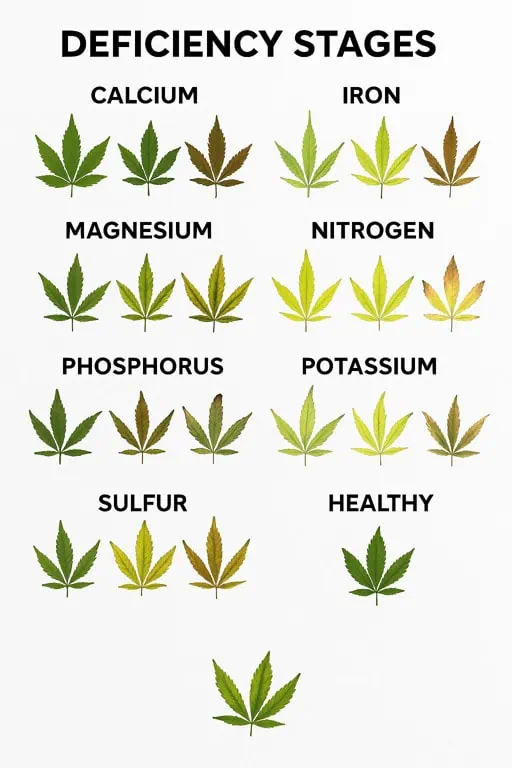
Cannabis plants require the right mix of macronutrients (like nitrogen, phosphorus, potassium) and micronutrients (such as iron, zinc, calcium, magnesium) to thrive. Even minor imbalances can result in visible symptoms like yellowing leaves, stunted growth, poor bud development, or diminished yield. Early detection and corrective action are essential.
Many nutrient deficiencies are not due to a lack of nutrients—but rather due to incorrect pH—leading to “lockout,” where nutrients aren’t absorbed effectively. Keep your growing medium’s pH within these ranges:
Always check pH after adding nutrients and before feeding. If symptoms appear, test runoff pH too—this can guide whether the issue lies in uptake or nutrient content.
Sending samples for lab analysis is the best way to know exactly what your plants—or soil—are missing. Identify BOTH deficiency and excess (toxicity), then tailor amendments precisely.
Common signs are yellowing leaves, yellowing between green veins, brown or burnt edges and tips, purple or dark leaves, curling, and slow growth. Where the symptoms start, on old leaves or new growth, tells you which nutrients to suspect.
Mobile nutrients: nitrogen, phosphorus, potassium, magnesium, and molybdenum. A uniform yellowing of the lowest leaves that moves upward is the classic sign of nitrogen deficiency.
Yes. Many deficiencies are lockout, not a lack of nutrients. Keep soil at about 6.0–7.0 and coco or hydro at about 5.5–6.5, and check runoff pH before adding more fertilizer.
Nutrient burn usually shows burnt, yellow-brown tips on otherwise dark green leaves after a heavy feeding. A deficiency develops more gradually and follows a pattern on old or new leaves.
More in Growing

Check your state's cannabis laws

Indoor + outdoor growing careers
 IACET Accredited Provider · online cannabis education
Since 2009 • 50,000+ students trained worldwide
IACET Accredited Provider · online cannabis education
Since 2009 • 50,000+ students trained worldwide



Copyright Cannabis Training University, a subsidiary of Online Training Providers. © 2026. All Rights Reserved.
Medical Disclaimer: The information on this website is for informational purposes only and is not intended to be a substitute for professional medical advice, diagnosis, or treatment.
Always seek the advice of a physician or other qualified health provider with any questions you may have regarding a medical condition.
Legal Compliance: Cannabis remains federally illegal. Products and information are intended only for jurisdictions where cannabis use and possession is legal.
By using this site, you affirm that you are of legal age (21+) and responsible for understanding your local laws.