


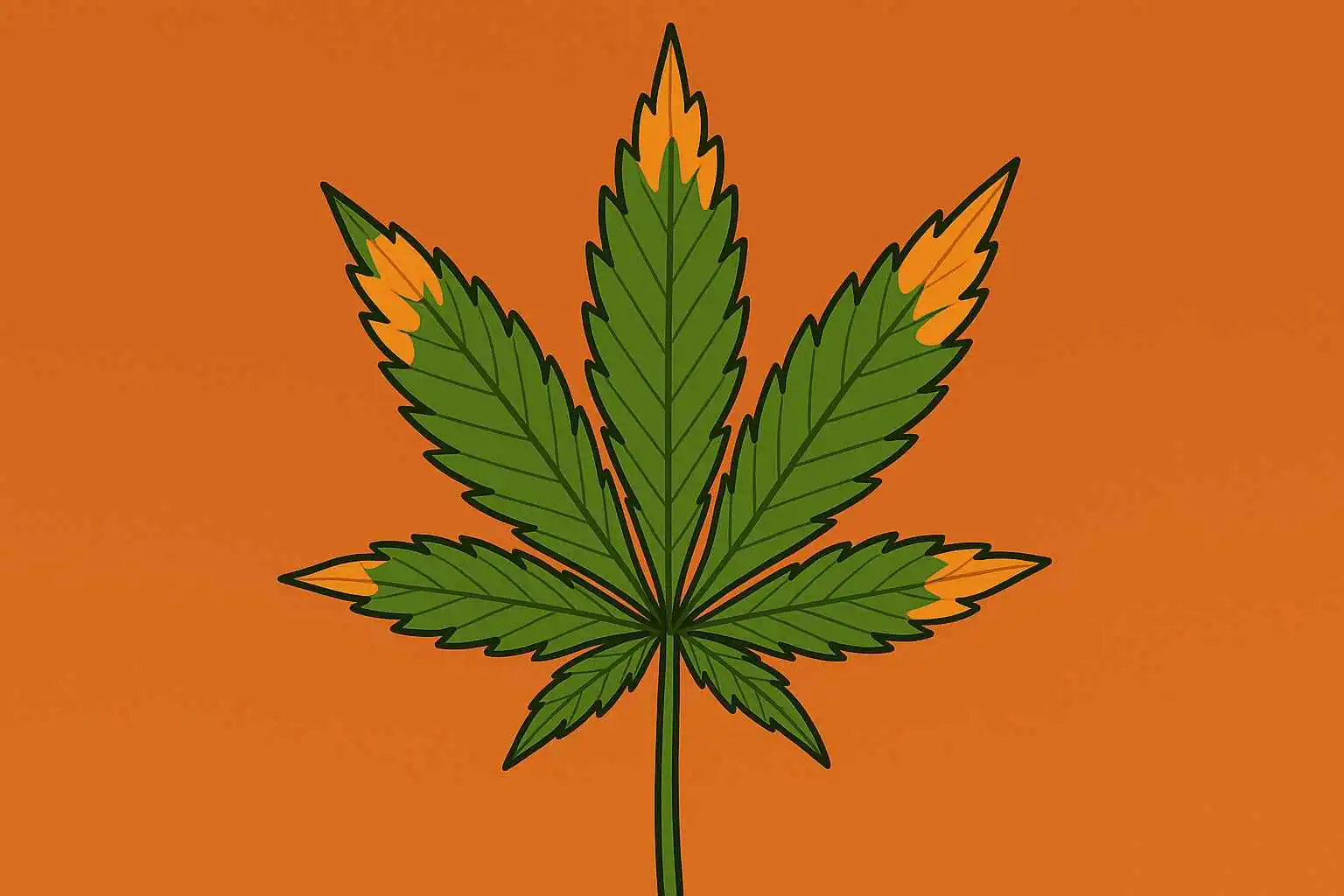
Among the 17 essential elements that cannabis needs, potassium (K) ranks high on the list of primary macronutrients, right alongside nitrogen (N) and phosphorus (P).
While nitrogen drives leafy growth and phosphorus powers root and flower development, potassium is the master regulator of plant health.
Potassium is crucial for energy production in cannabis, supporting all stages of plant growth.
It governs water uptake, enzyme activation, sugar transport, stress resistance, and overall vigor.
When potassium levels drop too low, cannabis plants struggle to photosynthesize efficiently, leading to weak stems, discolored leaves, stunted growth, poor flower formation, and lower THC and terpene levels.
Marijuana potassium deficiency is a common issue that can negatively impact plant growth and energy production.
This guide explores how to diagnose, correct, and prevent potassium deficiency in cannabis across all grow systems, soil, hydroponic, and coco, with real-world tips from seasoned cultivators.
The Role of Potassium in Cannabis Plants
Potassium acts as a multitasking electrolyte within cannabis tissue and is essential for many physiological functions. Potassium plays a crucial role in plant physiology, supporting growth, flowering, and overall plant health.
It is distributed throughout plant tissues, including the phloem and xylem, which are vital for nutrient and water transport.
- Regulates Osmosis: Potassium balances water pressure within cells, keeping leaves turgid and aiding transpiration.
- Activates Enzymes: Over 60 plant enzymes rely on K⁺ to catalyze vital processes like carbohydrate metabolism and protein synthesis. Potassium plays a key role in metabolic processes throughout the plant.
- Improves Photosynthesis: Potassium enables optimal CO₂ absorption through stomata (leaf pores).
- Transports Sugars: It moves carbohydrates from leaves to flowers, ensuring fat buds and resin production. Potassium is also vital for nutrient transport, moving nutrients and water efficiently through plant tissues.
- Boosts Disease Resistance: Well-fed plants resist pathogens and environmental stress better.
- Influences Quality: It enhances terpene, cannabinoid, and resin production, directly affecting potency and flavor.
What Causes Potassium Deficiency in Cannabis?
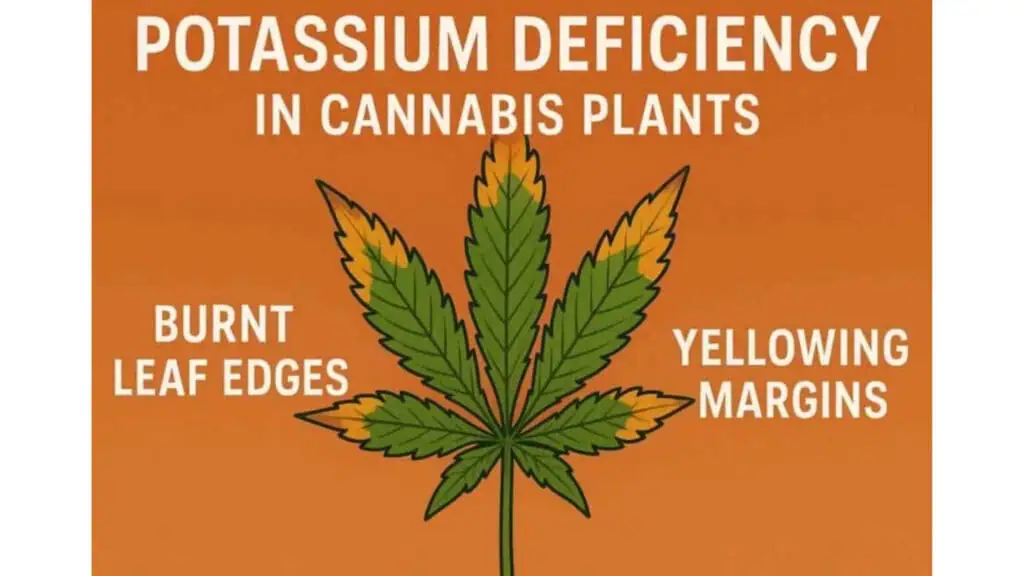
Potassium deficiency rarely occurs because potassium is absent in the soil or nutrients, rather, it happens when the plant can’t absorb what’s available.
Improper pH levels and soil compaction can reduce nutrient availability and the plant's ability to absorb potassium, even when potassium is present in the soil.
1. Nutrient Lockout
- pH imbalance is the leading cause. In soil, potassium is absorbed best at a pH of 6.0–7.0 because soil pH directly affects the plant's ability to absorb potassium and other essential nutrients.
- In hydroponics/coco, the ideal range is 5.8–6.2. If the pH drifts too high or too low, the roots can’t take up K even if it’s present. Maintaining optimal soil pH is crucial for nutrient availability and helps prevent potassium deficiency.
2. Excess Calcium, Magnesium, or Sodium
Overuse of cal-mag supplements or salty tap water can create an antagonistic interaction.
Too much calcium can block potassium uptake and contribute to deficiency. Calcium (Ca²⁺), magnesium (Mg²⁺), and sodium (Na⁺) compete with potassium (K⁺) for uptake sites on root membranes.
3. Overwatering or Poor Drainage
Saturated soil deprives roots of oxygen, inhibiting nutrient uptake, a condition called root hypoxia. Soil compaction can also contribute to poor drainage and root hypoxia, further limiting potassium uptake.
4. Root Damage or Disease
Fungal pathogens like Pythium can destroy root hairs, cutting off potassium absorption.
5. Cold Soil or Grow Medium
Low temperatures slow ion mobility and uptake efficiency.
6. Inadequate Feeding During Flowering
Cannabis demands more potassium during the bloom stage, especially weeks 3–7 of flowering, to support dense bud formation.
It is crucial to provide enough potassium not only during flowering but also throughout vegetative growth, as insufficient potassium can lead to deficiency symptoms and impair healthy plant development.
Many growers underfeed K during this phase.
Early Signs of Potassium Deficiency in Cannabis
Potassium deficiency tends to appear on older, lower leaves first, since K is a mobile nutrient that the plant can relocate from older tissue to new growth.
Identifying potassium deficiency early is crucial to protect the overall plant structure, as delayed detection can lead to more severe damage affecting leaves, stems, and general growth patterns.
Look for the following early warning signs:
Symptom | Description |
|---|---|
Leaf Tip Burn | Browning and burning of leaf tips is a classic early sign; yellowing or browning begins at the edges and tips of older leaves. |
Marginal Chlorosis | Yellowing along the leaf margins that progresses inward. |
Brown Spots (Necrosis) | Dead, crispy patches appear along the edges and tips. |
Weak Stems | Branches may droop or break under the weight of buds. |
Reduced Growth | Stunted development and smaller leaf size. |
Slower Flowering | Bud formation lags behind schedule. |
Visual Cue: The characteristic look of potassium deficiency is “burnt leaf edges” with green veins intact, often mistaken for nutrient burn, but the difference lies in the pattern and progression.
Monitor overall plant structure for changes, as symptoms can affect not just leaves but also stems and the plant’s general form.
Advanced Symptoms and Late-Stage Effects
If ignored, potassium deficiency escalates rapidly and severely impacts overall plant health, leading to weakened plant structure:
- Leaf edges curl upward, resembling a taco shape.
- Brown necrotic margins spread toward the center.
- Stems become brittle and break easily.
- Lower leaves die off prematurely.
- Bud development halts, resulting in light, airy flowers.
- THC and terpene content plummet, impacting potency and flavor.
- Plants become more susceptible to pests, drought, and temperature stress.
At this stage, correction is still possible, but yield recovery is limited.
Diagnosing Potassium Deficiency vs. Other Problems
Potassium deficiency can look similar to other issues.
Potassium deficiencies are common in weed plants and can often be confused with other nutrient problems, making accurate diagnosis important. Here’s how to distinguish it:
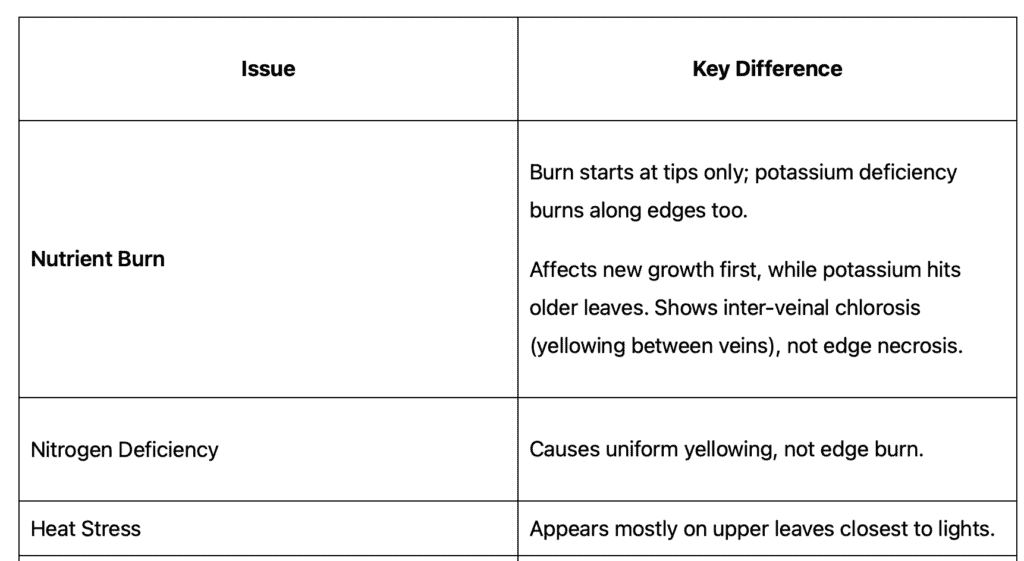
For absolute certainty, use:
- EC/TDS meter to check feed strength
- pH meter for root zone accuracy
- Leaf tissue analysis or soil test (lab-based) for confirmation
Correcting Potassium Deficiency (Step-by-Step)
Once identified, taking prompt action to fix potassium deficiency is crucial to restore plant health and prevent irreversible yield loss.
Step 1: Flush and Reset pH
- Use pH-balanced water (6.0–6.2) for hydro/coco, 6.5 for soil.
- Flush with 2–3x the container volume to remove built-up salts or lockout.
- Let the medium drain thoroughly.
Step 2: Adjust Feeding Regimen
Feed with a balanced nutrient solution that provides sufficient potassium but not excessive nitrogen.
Look for:
- N-P-K ratio emphasizing K during bloom, e.g., 1-3-2, 2-4-5, or 4-8-12.
- Supplements like:
- Potassium sulfate (K₂SO₄) — organic, low chloride.
- Monopotassium phosphate (KH₂PO₄) — excellent for hydroponics.
- Potassium chloride — commonly used in hydroponic and gardening setups as a source of potassium; monitor its use to avoid excess chloride in the nutrient solution.
- Seaweed or kelp extracts — provide potassium and trace minerals naturally.
- Langbeinite (Sul-Po-Mag) — organic triple source of K, Mg, and S.
Step 3: Check and Correct pH Drift
Maintain consistent pH to prevent future lockout:
- Soil: 6.0–7.0
- Coco/hydro: 5.8–6.2
Use quality pH Up/Down solutions, and always measure runoff pH.
Step 4: Enhance Root Health
Add:
- Mycorrhizal fungi (e.g., Great White, Mykos)
- Humic and fulvic acids to improve nutrient chelation
- Silica supplements to strengthen stems and resistance
Step 5: Monitor and Recover
- Expect visible improvement within 5–10 days.
- Prune severely damaged leaves to redirect energy.
- Resume normal feeding once new growth looks vibrant green.
Foliar Spray Application for Rapid Potassium Correction
When potassium deficiency strikes your cannabis plants, time is of the essence, especially during the critical flowering stage.
Foliar spray application offers a fast and effective way to restore potassium levels directly through the leaves, bypassing any root zone issues that might block potassium uptake.
By delivering a potassium-rich nutrient solution, such as one made with potassium nitrate or potassium bicarbonate, straight to the plant’s foliage, you can quickly address deficiency symptoms and support healthy bud development.
To apply a foliar spray, simply mix your chosen potassium-rich fertilizer with water according to the manufacturer’s guidelines.
Using a fine mist sprayer, coat both the tops and undersides of the leaves thoroughly, ideally during the early morning or late evening to avoid leaf burn.
This method is particularly useful if your cannabis plants are showing signs of potassium deficiency during the flowering stage, when their demand for this vital nutrient peaks.
Remember, foliar sprays are a rapid-response tool and should be used alongside adjustments to your soil or hydroponic nutrient solution for long-term correction.
By combining foliar feeding with proper root zone management, you can ensure your cannabis plants recover quickly and continue to thrive.
Potassium in the Flowering Stage
During flowering, potassium demands surge dramatically. It helps transfer sugars and energy to buds, leading to dense, trichome-rich flowers.
A deficiency at this stage can devastate yields, leading to:
- Fluffy buds
- Poor aroma and taste
- Delayed ripening
- Reduced resin gland density
To prevent this:
- Switch to bloom nutrients by week 3 of flowering.
- Use K-boosters during peak bloom (weeks 5–7).
- Always maintain EC within 1.6–2.0 for soil and 2.0–2.4 for hydro, depending on strain and environment.
Organic Remedies for Potassium Deficiency
If you’re growing organically, here are natural sources of potassium. These organic amendments supply vital nutrients, including potassium, to support healthy plant growth:
Source | Description |
|---|---|
Kelp Meal | Rich in K and micronutrients; also enhances stress resistance. |
Wood Ash | Fast-release K source; use sparingly to avoid raising pH too high. |
Boosts microbial life and improves nutrient uptake. | |
Molasses | Provides K and carbohydrates for soil microbes. |
Langbeinite (Sul-Po-Mag) | Natural mineral supplement containing K, Mg, and S. |
Banana Peel Tea | Old-school remedy rich in soluble potassium. |
Mix these into the soil or brew them into teas to feed during flowering.
Potassium Interactions with Other Nutrients
Nutrient balance is crucial. Potassium interacts with nearly every essential element in the cannabis nutrient web:
To maintain harmony:
- Use filtered or RO water if Na is high.
- Alternate feeding between base nutrients and microbial teas.
- Avoid stacking multiple potassium-heavy boosters simultaneously.
Magnesium Deficiency Connection: How Potassium Imbalance Affects Magnesium Uptake
Potassium and magnesium are both essential nutrients for cannabis plants, but their relationship is a delicate balancing act. In plant physiology, these two elements compete for absorption at the root level.
If potassium levels become too high, it can block magnesium uptake, leading to magnesium deficiency—a common secondary issue in cannabis cultivation.
Conversely, a lack of potassium can also disrupt magnesium availability, further impacting plant health.
Magnesium deficiency often presents as interveinal chlorosis (yellowing between the veins) and can stunt growth or reduce yields if left unchecked.
To prevent this, it’s crucial to monitor nutrient levels closely and maintain a balanced feeding regimen that supplies both potassium and magnesium in the right proportions.
Regularly checking your nutrient solution and soil for proper levels of these essential nutrients will help your cannabis plants absorb what they need for robust growth and optimal development.
By understanding the interplay between potassium and magnesium, growers can avoid nutrient imbalances that lead to deficiency symptoms and ensure their cannabis plants remain healthy throughout all stages of growth.
Environmental Factors That Influence Potassium Uptake
Potassium availability is sensitive to environmental conditions:
- Temperature: Optimal root uptake occurs between 68–77°F (20–25°C).
- Humidity: Low humidity increases transpiration, raising K demand.
- CO₂ Enrichment: Plants under CO₂ supplementation need extra potassium.
- Light Intensity: Higher PPFD (LED intensity) requires stronger K support for photosynthesis.
Always adjust nutrient strength based on environmental vigor.
Potassium in Hydroponic & Coco Systems
Potassium deficiency appears more quickly in hydroponics and coco coir than in soil because these media have low nutrient buffering capacity.
Tips for Hydro Growers:
- Use high-quality bloom nutrients (like General Hydroponics, Athena, or Advanced Nutrients) with balanced K.
- Maintain EC between 1.8–2.2 and pH 5.8–6.2.
- Check for salt buildup weekly and flush with clean water or enzyme solution.
- Use silica and cal-mag carefully to avoid lockout.
Tips for Coco Growers:
- Buffer coco before use with cal-mag.
- Use coco-specific nutrients with increased K levels.
- Ensure 20% runoff to prevent salt accumulation.
How Potassium Deficiency Affects Yield and Quality
Aspect | Effect |
|---|---|
Yield | Up to 40% reduction in dry weight in severe cases. |
THC Levels | Lower resin gland density reduces potency. |
Terpenes | Weaker aroma and flavor profile due to impaired sugar transport. |
Bud Density | Airy, less compact flowers. |
Color and Curing | Poor chlorophyll degradation leads to uneven curing. |
Growers who maintain proper K levels report heavier, stickier, and more aromatic harvests.
Quick Reference Chart: Potassium Levels Through the Grow Cycle
Growth Stage | Ideal K Ratio (N:P:K) | Notes |
|---|---|---|
Seedling | 2-1-2 | Gentle feed; avoid high EC. |
Vegetative | 3-1-3 | Promotes strong roots and stems. |
Early Flowering | 2-2-4 | Support bud initiation. |
Mid-Flowering | 1-3-5 | Peak potassium demand. |
Late Flowering | 0-3-7 | Finishing booster phase. |
Excess Potassium Risks: When Too Much is a Problem
While potassium is vital for cannabis plant health, more isn’t always better. Excess potassium in the nutrient solution or soil can cause a range of problems, starting with stunted growth and progressing to leaf burn and reduced water uptake.
High potassium levels can also trigger nutrient lockout, preventing your plants from absorbing other essential nutrients like magnesium and calcium. This imbalance can quickly lead to secondary deficiencies, weak stems, and poor flower production.
Potassium toxicity, the result of prolonged excess potassium, often shows up as yellowing leaves, brittle stems, and diminished bud quality. To avoid these risks, it’s important to monitor potassium levels regularly and adjust your fertilization practices as needed.
Be cautious when using potassium-rich fertilizers, and always test your soil or nutrient solution to catch any buildup before it affects your crop.
By keeping a close eye on nutrient levels and practicing moderation, you can prevent excess potassium from undermining your cannabis plants’ health and ensure a successful, high-quality harvest.
Common Mistakes Growers Make
- Confusing K Deficiency with Burn: Edge necrosis resembles overfeeding but is usually lockout-related.
- Ignoring pH Drift: Even small changes block uptake.
- Overusing Additives: Stacking bloom boosters and cal-mag together causes ion competition.
- Not Flushing Enough: Salt buildup quietly sabotages nutrient balance.
- Feeding Uniformly Across Strains: Some genetics (e.g., sativas) need less K than heavy indicas.
Expert Grower Tip
“If you're growing with LEDs and CO₂, think of potassium as your octane booster. High-performance environments demand high-performance nutrition.” — Jeff Zorn, Founder, Cannabis Training University
Potassium Deficiency In Cannabis Plants FAQ's
Can potassium deficiency be reversed completely?
Yes, if caught early. Within 7–10 days, new leaves will appear green and healthy. However, damaged leaves won't recover — prune them to focus energy on new growth.
How often should I add potassium during flowering?
Regular feeding with a bloom nutrient is enough. Supplement with K boosters once weekly if signs of deficiency appear.
What does potassium lockout look like?
Burnt leaf edges with yellow halos, often paired with high runoff EC and incorrect pH readings.
Can too much potassium cause problems?
Yes. Over-supplementation can lock out calcium and magnesium, leading to brittle stems and interveinal chlorosis.
Is potassium deficiency more common indoors or outdoors?
More common indoors, especially in hydroponic and coco setups, due to tight pH ranges and high nutrient turnover.
Does potassium affect taste or smell?
Absolutely. Potassium is essential for sugar transport and terpene synthesis — deficiencies lead to bland, less aromatic buds.
Should I use banana peels or molasses as potassium boosters?
Yes, for organic soil grows. Banana peel tea and molasses provide gentle K release and improve microbial activity.
Can LED lighting increase potassium demand?
Yes. Intense light and CO₂ enrichment accelerate metabolism, requiring higher potassium levels to sustain growth.
What's the best way to test for potassium deficiency?
Use a pH/EC meter to test runoff and consider sending a leaf tissue sample to a lab for mineral analysis
How can I prevent it next grow?
Track nutrient schedules, calibrate meters weekly, flush monthly, and document symptoms to adjust future feeding.
Conclusion On Potassium Deficiency In Cannabis Plants
Potassium deficiency is one of the most common yet misunderstood issues in cannabis cultivation. It's not just about feeding more K — it's about ensuring that your plant can access and utilize it efficiently.
By understanding the interactions, maintaining balanced pH, and adjusting your nutrient strategy, you can keep your cannabis thriving from seedling to harvest. The payoff? Heavier yields, stronger stems, richer terpenes, and higher THC content, everything a serious grower aims for.

Luis Cordova
Luis Cordova is a distinguished author, and renowned expert in cannabis cultivation, who possesses a Master's degree in Plant Biotechnology and Pharmaceutical Science. As a valued contributor to highly esteemed publications such as Cannabis Training University and Maximum Yield Magazine, Luis has emerged as a trusted source of guidance and knowledge in the cannabis industry. Having written thousands of informative articles, Luis is widely recognized for his comprehensive expertise on cultivating cannabis, both indoors and outdoors.


 Jeff was involved in an accident where he endured a traumatic brain injury. He had a week-long stay in ICU where brain surgeons
  100% risk free money back guarantee within 48 hours after purchase if student has not completed any of the courses or exams.
