Delta-8 THC has become increasingly popular as a smoother, legal alternative to delta-9 THC. But one of the most common questions people ask is: How long does delta-8 stay in your system?
The answer isn’t the same for everyone, it depends on metabolism, frequency of use, dosage, and type of drug test. Here’s what the science says.
Delta-8-tetrahydrocannabinol (delta-8 THC) is a cannabinoid that occurs naturally in cannabis and hemp. It produces milder psychoactive effects than delta-9 THC but is processed by the body in similar ways.
After consumption, delta-8 is metabolized by the liver into compounds such as 11-hydroxy-THC and THC-COOH. Because these metabolites are fat-soluble, they can linger in fat tissue and slowly release back into the bloodstream over time, which explains why cannabinoids are detectable long after their effects fade.

Yes. Drug tests typically cannot tell the difference between delta-8 THC and delta-9 THC because both break down into similar metabolites. Even if you’re using a legal hemp-derived delta-8 product, you can still test positive for THC.
There is no proven way to “flush” delta-8 out of your system instantly. Some factors that may support natural detoxification include:
That said, the only 100% reliable method is giving your body enough time to clear the metabolites naturally
Hydration helps your body function efficiently, but it won’t “wash away” THC metabolites overnight. It may slightly aid elimination, but time is still the main factor.
Yes. CBD is non-intoxicating and typically clears faster since it does not produce the same fat-stored metabolites as THC. Delta-8 can linger for weeks, while CBD usually clears in days.
Yes. Edibles pass through the digestive system and liver, producing 11-hydroxy-THC, a potent metabolite that lasts longer. Vaping or smoking typically clears faster.
Occasional users may only need a week, while heavy daily users may need 30+ days to test clean. The safest approach is to abstain for at least a month if you know a test is coming.
Yes. Since THC metabolites are stored in fat cells, individuals with higher body fat may retain them longer than leaner individuals.
Many commercial detox kits claim to speed up clearance, but most lack scientific evidence. At best, they may temporarily dilute urine, which testing labs can detect.
They’re nearly identical in how long they stay in the body because they metabolize into similar compounds. If you test positive for THC, the test won’t distinguish between the two.
Delta-8 THC, generally made from hemp, falls under a legal gray area and can carry some health risks if you are not careful.
Here is what you need to know about delta-8 THC.
“The science is clear: Delta-8 THC is milder in effect than delta-9, but your body still processes it in very similar ways. That means users should expect nearly identical detection times on drug tests.” — Jeff Zorn, CEO of Cannabis Training University
Delta-8 THC is a mildly intoxicating cannabinoid found in trace amounts in hemp and cannabis.
Delta-8 THC works similarly to delta-9 THC, the primary intoxicating compound in the cannabis plant. The difference in chemical structure between delta-8 THC and delta-9 THC is the cause of their difference in potency.
The majority of delta-8 products are made from hemp, which is legal to grow in the US. Generally, processors extract CBD isolate from hemp and then synthesize it into delta-8.
An acid reagent is used to trigger a chemical reaction in the CBD isolate. The extract is then neutralized with an alkaline material. Delta-9 THC is purged from the extract leaving behind a pure delta-8 product.
What is delta 8 like as far as the effects? Similar to delta-9 THC, delta-8 THC can produce euphoric and relaxing effects.
Delta-8 THC’s subdued effects can provide mild relief for minor aches and pains. It does not produce an intense high like delta-9 THC. Still, research on delta-8’s effects, benefits, and risks is still in its infancy.
Delta-8 THC’s side effects are similar to delta-9 THC’s side effects. Common side effects include:
Apart from its common and mild side effects, delta-8’s manufacturing process using hemp-derived CBD may produce harmful byproducts in the final product, especially if it is not tested by an independent lab for purity and potency.
In some cases, untested delta-8 products can contain delta-9 and delta-10 THC compounds. Research on delta-10 THC is also limited.
While these THC derivatives may not cause adverse side effects, there still may be harmful byproducts that can be unsafe to consume.
Delta-8 THC has a similar but different chemical structure as the highly intoxicating delta-9 THC compound. While delta-8 THC can produce a high, it is much milder than a high from delta-9 THC.
A majority of delta-8 products are made from hemp-derived CBD. The 2018 Farm Bill legalized the production of industrial hemp products.
Hemp products with less than 0.3% THC are legal now, but the bill does not address delta-8. As a result, many hemp producers use this loophole to sell delta-8 products across the country.
Delta-8 is now one of the fastest-growing products in the hemp market. Due to the unregulated nature of the market, many in the industry are worried about potential impurities and lack of testing in the production of delta-8 THC.
Due to these concerns, many states, including Colorado and New York, have banned the use of Delta-8 THC.

Delta-8 THC and delta 9 THC both produce intoxicating effects, although delta-8 THC’s high is much more subtle than delta-9 THC’s high.
In terms of their chemical structure, both compounds have double bonds and a chain of carbon atoms. Delta-8 THC has its double bonds on the eighth carbon atom, while delta-9 has it on the ninth carbon.
Due to the novelty of the compound and the trace amounts found in cannabis, there is not too much research on delta-8 THC.
Much of its medical uses have been anecdotal reports on social media posts, forums, blog posts, and more. What medical uses are delta8 used for?
Users have reported using delta-8 for the following:
The benefits of delta 8 THC, is sometimes believed to be a compromise between CBD and delta 9 THC.
In a manner analogous to that of Delta 9 THC and CBD, it binds to the CB1 and CB2 receptors, so making a contribution to the control of homeostasis inside the body.
Because of the diminished potency of its effects, it is a more prudent choice for people who wish to steer clear of the anxiety and paranoia that are occasionally brought on by Delta 9 THC.
It is possible that it is more efficient than Delta 9 THC in stimulating appetite, as some research suggest that its effect on appetite could be twice as great.
While delta-8 THC has seemingly worked for many users, the limited research does not fully support these claims. For this reason, we recommend users take caution when buying and using delta-8 products. Many of these products may not be safe to use.
There is some controversy in the industry surrounding the sale and use of delta-8 THC products such as pre-rolled joints, tinctures, and vapes.
Since delta-8 THC production is not regulated properly, the synthetic production of delta-8 THC from hemp can create harmful compounds that can cause adverse side effects.
Delta-8 THC products are available nearly everywhere nowadays from gas stations to convenience stores to dispensaries to online retailers.
Customers can buy a wide range of delta-8 products including edibles such as gummies and candies, tinctures, pre-rolled joints, beverages, and vape pens.
Keep in mind, delta-8 products vary in quality. We recommend doing as much research about the producer and their products.
Look up how they source their cannabis or hemp and their processing methods that make delta-8 THC. Always choose products that have been lab tested for harmful substances. Delta 8 thc products are being sold all over the US and sometimes by suspect retailers.
In some people delta 8 THC can still be detected in the body after 30 days after consumption, and in others, delta 8 isn’t detectable after two days. So it’s important to consider the factors mentioned above.
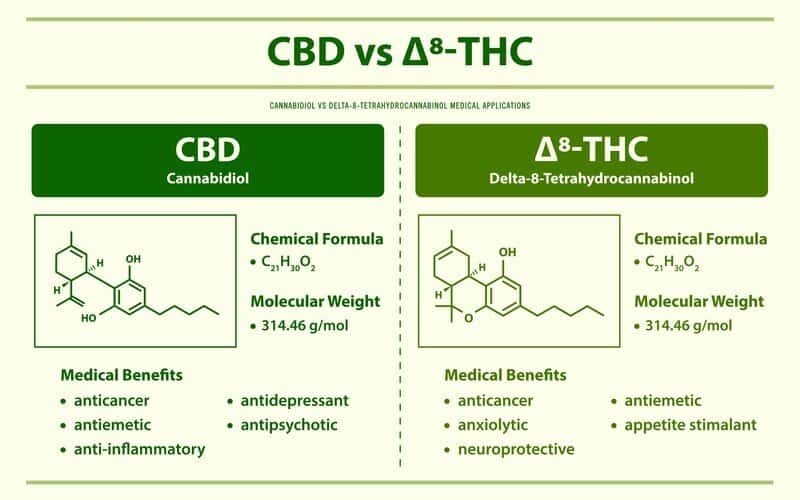
While they share many similarities in effects, it is vital to understand the critical differences in their legality, effects, and potency.
CBD is found in higher concentrations in the hemp plant. Cannabis plants can be bred to contain a higher percentage of CBD. However, most CBD products are made using hemp.
Hemp-derived extracts, topicals, and edibles are made using a CBD concentrate. CBD can be extracted using solvent-based and solventless extraction processes.
Delta-8 THC is usually made with the hemp plant and found in very small concentrations. Using a closed-loop extraction process, processors extract a CBD isolate from the plant material and use a synthetic process to convert the CBD isolate into the delta-8 cannabinoid.
Due to the lack of regulation on delta-8 products, there is a higher risk of products containing contaminants.
The 2018 Farm Bill legalized the industrial production of hemp plants that contain less than 0.3% delta-9 THC by dry weight. Cannabis products containing a THC percentage over this limit are a Schedule I substance that is federally illegal.
Under federal law, there is no explicit prohibition of delta-8 THC, which is a loophole used by producers and processors to “legally” sell delta-8 THC products in a legal gray area. As a result, many states have moved to restrict or ban delta-8 THC. At the moment, its legal status is unclear.
In terms of psychoactive effects, delta-8 THC and CBD affect the mind and mental state differently. For example, CBD does not cause an intoxicating effect. Delta-8 THC is known to produce a milder form of intoxication compared to its delta-9 THC analog.
In high doses, delta-8 THC can produce effects of overconsumption, especially for first-time or low-tolerance users.
Both CBD and delta-8 THC have been shown to provide pain relief, anxiety relief, anti-inflammatory effects, and cancer-inhibiting properties. Delta-8 may stimulate appetite, while CBD can suppress appetite.
Most people experience no side effects from CBD, although it can produce mild side effects such as dry mouth, lack of appetite, and sleepiness.
Delta-8 THC’s side effects include fatigue, reduced heart rate, and low blood pressure. Most adverse effects from delta-8 THC reported to poison control centers are due to accidental consumption of edibles.
Most CBD products that have been lab-tested will not make you fail a drug test. However, when you eat a delta-8 THC edible, the cannabinoid is metabolized in the liver and converted into a THC metabolite detected by a urine drug test.
There is little risk for failing a drug test when delta-8 is inhaled or consumed sublingually or topically.
As many states restrict or outright ban delta-8 THC products, the Drug Enforcement Administration (DEA) has announced that Delta-8 THC is federally legal.
While many companies race to ramp up the production of delta-8 products across the country, industry experts warn that there may still be some compliance issues with the production of hemp-derived delta-8. Is delta8 legal? Not always.
The DEA’s recent announcement on delta-8’s legality echoes a similar statement from a June 2021 virtual town hall hosted by the Florida Department of Agriculture and Consumer Services.
DEA Chief of Intergovernmental Affairs Sean Mitchell responded to a question about the legality of delta-8 THC.
Mitchell said, “what I want to say, and I’ll be very, very deliberate and clear, at this time—I repeat again, at this time—per the Farm Bill, the only thing that is a controlled substance is delta-9 THC greater than 0.3% based on a dry weight basis.”
In light of unclear federal regulations on delta-8 and other hemp derivatives, many states have taken matters into their own hands. For example, they have passed rules to restrict or ban hemp-derived cannabinoids, including delta-8.
Regardless of how the DEA’s announcement is interpreted, whether you think delta-8 is legal or not, state regulations surrounding this cannabinoid are still in effect. The announcement does not overrule any delta-8 bans.
States began regulating the drug after the hemp-derived products market started to snowball. Currently, 19 states have restricted or banned the drug, with a handful of more states moving in the same direction.
In the meantime, the Food and Drug Administration (FDA), tasked with regulating cannabis-derived products, has warned customers about the possible adverse health effects of consuming contaminated delta-8 products.
To understand the cannabinoid better, the agency announced in October 2021 that it would use Reddit and other new data sources to learn more about how CBD and cannabis derivatives like delta-8 are being used.
According to their Cannabis-Derived Products Data Acceleration Plan, the agency “needs robust information about potential safety problems or adverse events associated with FDA regulated products, including [cannabis-derived products].”
The FDA plans to research these data sources for how the products are being used and consumer trends to protect consumers and regulate the relatively new industry.
The United States Patent and Trademark Office (USPTO) has taken a firm stance on its trademark policy regarding delta-8 products.
So far, about 40 trademark applications for delta-8 products and services have been filed, and only five have been taken up. The USPTO rejected all trademarks and cited the federally illegal status of delta-8.
Are you interested in learning more about the cannabis sativa plant? Do you want to learn how to grow cannabis plants at home?
Enroll in Cannabis Training University’s online marijuana school for a comprehensive insight into the plant’s compounds, how to use cannabis medicinally, and how to start a career or business in this fast-growing industry.
If you want to stay up-to-date with the latest cannabis developments in science, law, and culture, subscribe to the Cannabis Training University’s blog. For a complete cannabis education, enroll in Cannabis Training University.
More in Cannabis industry

Check your state's cannabis laws

Career progression / salary growth
Targets mid-career professionals
 IACET Accredited Provider · online cannabis education
Since 2009 • 50,000+ students trained worldwide


Copyright Cannabis Training University, a subsidiary of Online Training Providers. © 2026. All Rights Reserved.
Medical Disclaimer: The information on this website is for informational purposes only and is not intended to be a substitute for professional medical advice, diagnosis, or treatment.
Always seek the advice of a physician or other qualified health provider with any questions you may have regarding a medical condition.
Legal Compliance: Cannabis remains federally illegal. Products and information are intended only for jurisdictions where cannabis use and possession is legal.
By using this site, you affirm that you are of legal age (21+) and responsible for understanding your local laws.