


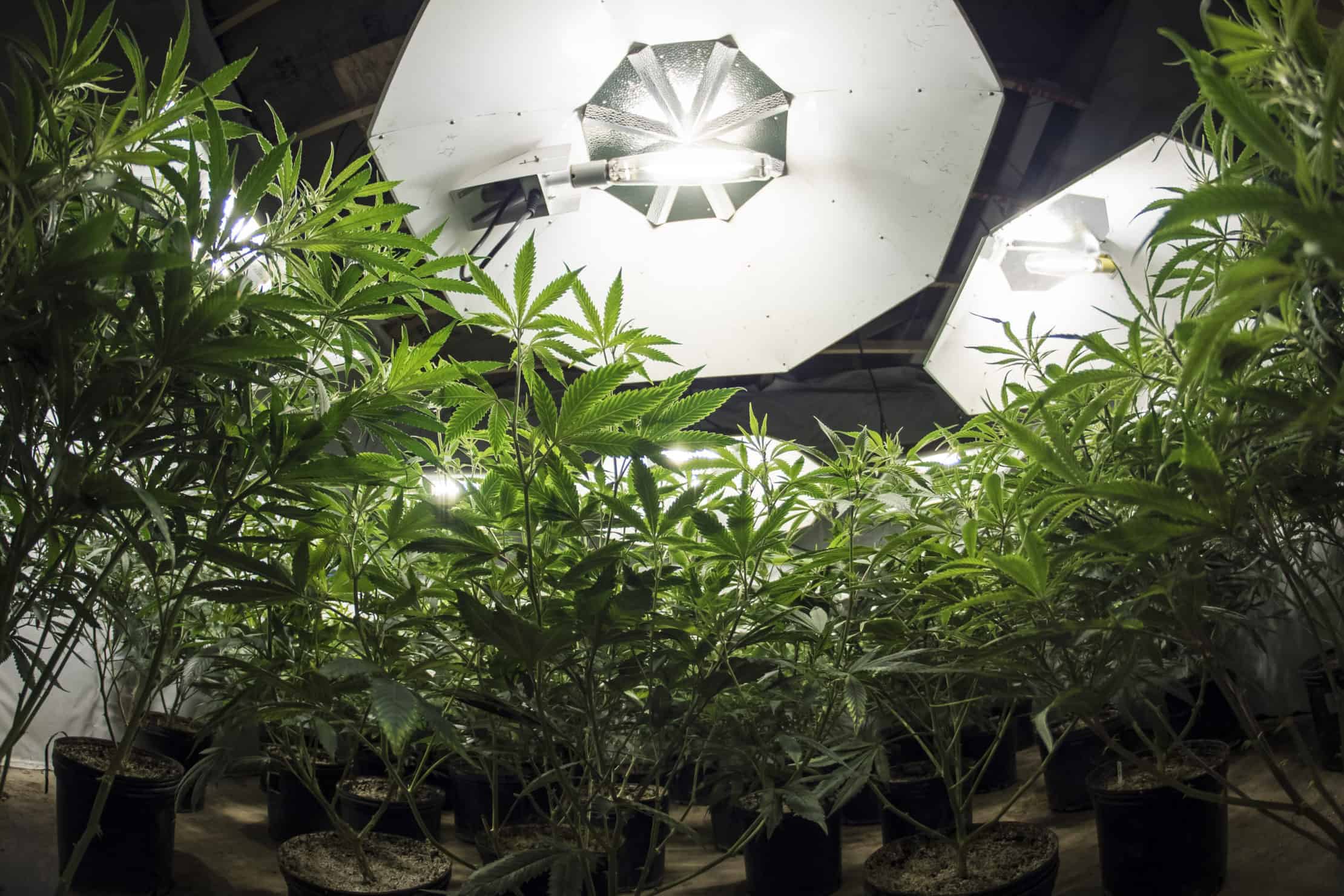
Let’s explore how a CFL grow light can be used for growing cannabis.
When it comes to indoor cultivation, there are several lighting options available, and CFL bulbs are becoming increasingly popular for good reason.
The best CFL lights can help you maximize yields even in small spaces, producing more cannabis than you might expect. Even beginners can achieve impressive yields with CFL lights if they follow proper guidelines.
Basically, CFL lights are the most beginner-friendly setup.
What Are CFL Bulbs?
CFL stands for compact fluorescent light.
Similar to the long fluorescent tubes commonly found in stores and offices, CFLs are designed in a compact bulb form, delivering the same benefits without the need for large fixtures.
The light emitted by CFLs is produced when ultraviolet light emitted by mercury atoms inside the bulb is converted into visible light by the phosphor coating on the inside of the glass.
They are available in a variety of base types, offering flexibility when planning or expanding a grow setup.
CFLs are energy-efficient and produce less heat compared to many other specialized cannabis grow lights, making them a practical choice for small to medium-sized grows.
CFL lights are the most beginner-friendly setup. They are also the best choice for small spaces.
Using CFL bulbs gives you the flexibility to switch between different light spectrums based on your plant’s growth stage.
During the vegetative stage, it’s best to use daylight-mimicking CFL bulbs, while a softer, warmer light is ideal for the flowering stage.
Avoid using soft white CFLs during vegging, as their spectrum is closer to autumn sunlight, which naturally signals plants to start flowering.
That said, if soft white bulbs are all you have access to, they can still work — just make sure you’re providing enough wattage to deliver sufficient light to each plant
Each plant will require around 80 watts of light, although more can be better.
Since CFL light bulbs don’t produce enough light exposure beyond around 12 inches, the lights will have to be adjustable with height to account for plant growth.
You can grow marijuana with CFL grow light bulbs in soil or hydroponically. Regardless of the growing medium, light needs remain the same.
Energy-efficient lightbulbs like CFLs are suitable for indoor plant growth, providing the necessary spectrum and intensity for healthy development.
While the wattage of the light produced by the CFL bulbs is more important than the spectrum of light, optimizing the spectrum is a good idea.
The best CFL for vegetative growth will be somewhere around 6500K. A softer spectrum around 2700K will be a good choice for a CFL flowering bulb.
These spectrums mimic natural daylight spectrums in Spring/Summer during the growing cycle and Autumn for the flowering cycle.
However, this doesn’t make or break your cannabis growing operation. If you don’t use a warm white CFL for flowering, you won’t ruin your marijuana.
Investing in a timer to turn the CFL lights on and off on an optimal schedule for the plant’s stages of life is a good idea. It’s also a good idea to invest in high-quality growing medium and nutrients to improve yields.
CFL Grow Light Coverage
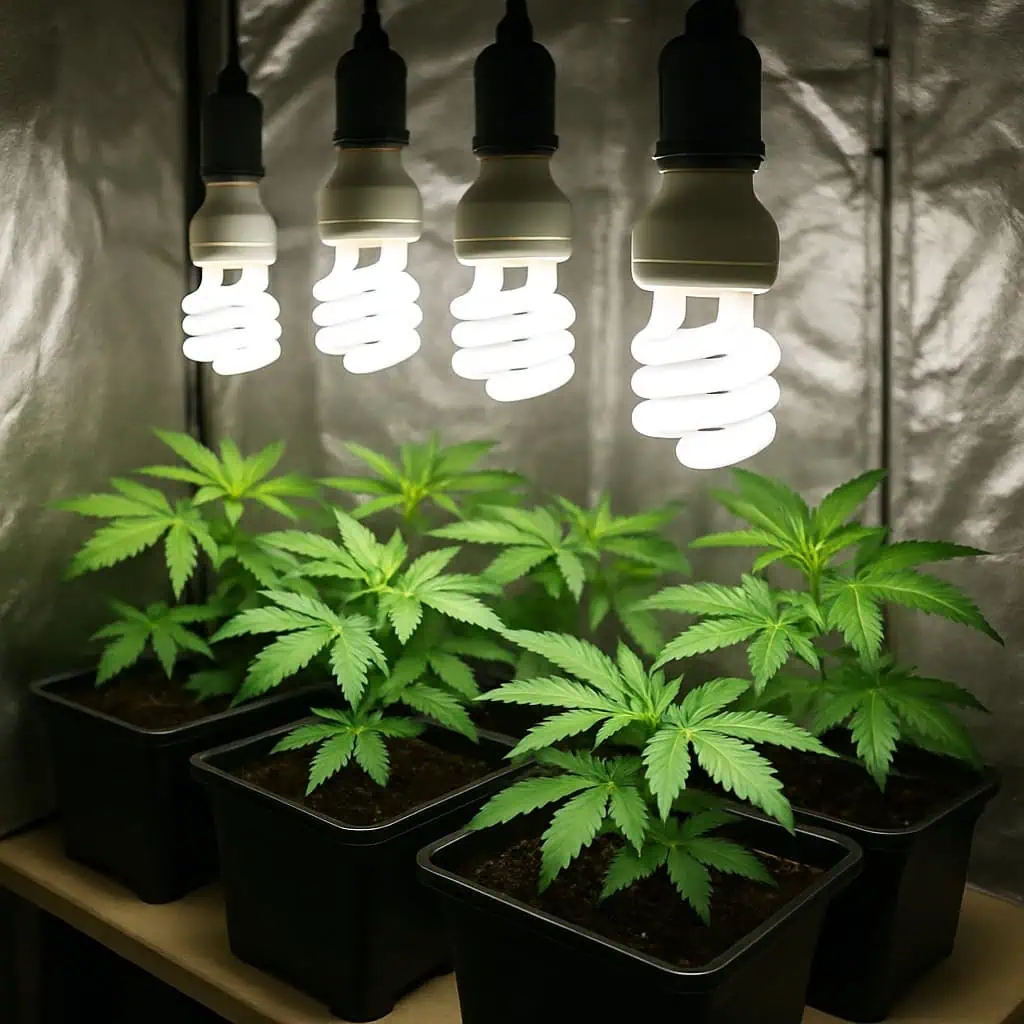
As mentioned, the coverage of one CFL bulb will only produce enough light exposure to about 12 inches away from the bulb itself, which is less than a foot.
This means that you’ll probably need multiple lights per plant to account for lateral growth, and providing more light can lead to better growth and higher yields. Keeping CFLs within a few feet of the plant canopy is important for optimal results.
Since CFL lights are only optimal up to about 12 inches below the light, it’s best to train your plants to grow horizontally instead of vertically. Training the branches to spread out and maximize light exposure will help increase yields and improve overall plant health.
Topping your plants and tying them to grow more laterally is the best way to ensure your plant can grow large without being too tall for CFL full spectrum grow bulbs. Training techniques, such as putting branches in optimal positions, help ensure even light distribution across the entire plant.
The CFL light spectrum isn’t as important as the total wattage of the light produced when growing cannabis, but it doesn’t hurt to use daylight simulating CFL bulbs during the growing stage and soft-white CFL bulbs during the flowering stage.
If you are trying to do a single CFL grow operation with only one bulb, you need a small plant that flowers quickly, like an autoflower variety.
Keep in mind that the yield of cannabis will be low with this setup. But, if you can’t spare more room than this, it’s still doable multiple times a year! For those aiming for maximum yields, consider learning more about growing ten pound plants.
Pros & Cons of CFL Bulbs For Growing Weed
Pros
- Affordable – Easy on the budget compared to HID or LED
- Easy to Find – Available at most stores that sell light bulbs.
- Common Household Bulbs – CFLs are widely used for household indoor lighting, making them easy to source for indoor grows.
- Beginner Friendly – Simple setup, no special equipment needed.
- Low Heat – Safer for small spaces, reduces risk of burning plants
- Good for Small Spaces – Perfect for closets, grow tents, or small rooms
- Customizable Spectrum – Use daylight bulbs for vegging and soft white for flowering.
Cons
- Lowe Light Intensity – Doesn’t penetrate deep into thick canopies.
- Limited Coverage – You’ll need multiple bulbs to cover even small grows.
- Constant Adjustments – Bulbs must stay close to plants, needing regular repositioning.
- Shorter Lifespan – Won’t last as long as LEDs.
- Not Ideal for Big Grows – Best for personal or hobby grows, not large yields.
- Useless for Large-Scale or Commercial Grows – CFLs are considered useless for higher-yield or commercial cannabis cultivation.
- Higher Cumulative Wattige – Many bulbs can add up in electricity use and space.
How To Get Big Buds With A CFL Bulb
To get big, productive buds when using fluorescent light bulbs, you need the most light intensity that you can produce. This is the most important factor when flowering with CFL lights.
For example, one beginner grower used a 200W CFL setup in a small grow tent and harvested over 2 ounces of dense buds, showing that impressive results are possible with the right approach.
The sun produces about 100,000 lumens per square foot, so the closer you can get to this number, the more productive your marijuana plants will be. However, a typical yield for a CFL grow is usually around 0.5 to 1 ounce per plant, depending on the setup and experience level, so set your expectations accordingly.
Building a hood for your CFL lights and concentrating them as close as possible during flowering will help mimic natural sunlight as much as possible.
Many novice cannabis growers do great with CFL setups during the vegetative stage but fail when the plants go to flower. If you want bigger, denser, more potent buds, you need maximal light intensity.
How Many CFL Bulbs For One Plant?
When setting up something like a small CFL closet grow, you might want as little light as possible.
Each cannabis plant will require around 80 watts of light, with more being better. Using 2 40 watt CFL bulbs is sufficient for a mini CFL grow. When plugging multiple CFL bulbs into sockets or splitters, always use quality plugs and sockets to ensure safety and efficient power delivery.
Keep in mind that the total power consumption of your CFL setup will impact your electricity costs, so consider the wattage and energy efficiency when planning your grow. For a basic CFL grow setup, you can expect to spend a modest amount on bulbs, plugs, and other necessary equipment.
Managing Heat and Humidity with CFL Grow Lights
When setting up a CFL grow in your grow tent or grow space, managing heat and humidity is essential for healthy plants and a successful harvest.
While compact fluorescent lamps (CFLs) produce less heat than many other grow lights, such as LEDs or HPS, they can still raise the temperature in a confined space, especially when you use more bulbs to increase light intensity.
To keep your environment suitable, aim for a temperature range of 65-75°F (18-24°C). This is ideal for most cannabis strains and helps prevent issues like burning or heat stress, which can damage seedlings and developing roots.
Good air circulation is key—installing a small fan or ensuring your grow tent has proper ventilation will help disperse heat and maintain fresh air around your plants.
Humidity also plays a big role in plant health. Seedlings and clones generally prefer higher humidity, above 50%, while mature plants do better with slightly lower levels. Because CFL bulbs emit less heat, they help maintain a more stable humidity level, reducing the risk of your grow space drying out too quickly.
However, always monitor both temperature and humidity with a reliable meter, adjusting your setup as needed to keep conditions optimal.
Positioning your CFL bulbs close to the plant canopy—typically 2-4 inches away—maximizes light output and closely matches the intensity your plants need for strong growth.
Just be careful not to place the bulbs so close that they burn the leaves. Adjust the height of your bulbs as your plants grow taller to maintain the right distance and avoid hot spots.
Color temperature is another important factor. Daylight CFL bulbs (around 6500K) are best for the vegetative stage, as their spectrum closely matches natural sunlight.
For flowering, switching to a warmer color temperature (around 2500K) can help your plants produce bigger, denser buds. Using the right color temperature at each stage ensures your plants get the light they need to thrive.
It’s also important to consider the environmental impact of CFLs. These bulbs contain a small amount of mercury vapor, so when they reach the end of their life, be sure to dispose of them properly at a recycling center to avoid environmental contamination.
While CFLs are generally more affordable upfront than LEDs, they use more electricity and have a shorter lifespan, which can increase your overall costs over time. Using more bulbs will boost light intensity and improve yields, but it also means higher energy bills and more heat to manage.
Regularly check your plants for signs of stress, and adjust the number of bulbs or their placement to keep your grow space balanced.
By carefully managing heat, humidity, and light intensity, you can create an environment where your cannabis plants will flourish under CFL grow lights. With the right setup, you’ll be well on your way to a healthy, productive harvest.
CFL Grow Lights For Growing Weed FAQ's
Are CFL lights effective for growing cannabis?
CFL lights can help small-scale cannabis growers, especially those with limited space. Their decreased light intensity and heat output make them ideal for seedlings and young plants. For example, one grower successfully grew cannabis from seed to harvest using only CFL lights, reporting healthy plants and a satisfying yield. They are less efficient for commercial or large-scale grows.
What are the benefits of using CFL lights for cannabis cultivation?
CFL lights are cheaper, energy-efficient, and emit less heat than HID lights. Using CFLs can save growers money compared to other lighting options, making them a cost-effective choice for cannabis cultivation. Their decreased heat output decreases plant heat stress and makes them perfect for stealth grows or confined places.
What spectrum of CFL light is best for cannabis growth?
Cannabis plants thrive under colder, blue lighting (6500K) during vegetative growth. For flowering, a warmer, red spectrum (2700K) is better. Growers may utilize multiple spectrums as the plant goes from vegetative to blooming.
How far should CFL lights be placed from cannabis plants?
Due of their lower intensity, CFL lights should be set 2-4 inches away from plants. However, the lights must not be too close to heat the plants.
Can I use regular CFL bulbs from a hardware store for growing cannabis?
Cannabis may be grown with normal CFL lights. However, bulbs should be the right wattage and color temperature (6500K for vegetative, 2700K for blooming). High-wattage bulbs work well.
How many CFL lights do I need for my grow space?
How many CFL lights you need depends on your grow space and plants. Generally, grow spaces should have 100 watts of CFL illumination per square foot.
How do CFL lights compare to LED or HID lights for growing cannabis?
CFLs are weaker and less efficient than LEDs and HIDs. They work well for small grows and are cost-effective, but not for larger operations or maximizing production and potency. HIDs and LEDs have a wider spectrum and higher light intensity.
Do I need to change CFL bulbs during the cannabis plant's lifecycle?
For vegetative and blooming development, utilize bulbs with various color temperatures (6500K and 2700K). Change bulbs or use a combination as the plant grows.
How often should CFL bulbs be replaced for optimal cannabis growth?
Even though they work like ordinary bulbs, CFL bulbs should be replaced every 6-12 months due to light intensity loss.
Is it necessary to have a cooling system when using CFL lights?
While CFL lights emit less heat than HID lights, appropriate ventilation is still vital, especially in enclosed spaces. Unlike HID lights, it requires a simpler cooling system.
CFL Grow Lights in 2025: Are They Still Worth It?
The cannabis lighting market has advanced dramatically in recent years. LEDs and ceramic metal halide (CMH) lights dominate today's discussions, but CFLs (compact fluorescent lights) remain relevant for specific growers.
They continue to be an affordable, entry-level option for micro-grows, seedling and clone stages, and stealth setups where space and heat are concerns.
Industry Update: Where CFLs Fit Today
- Seedling and Clone Stage: CFLs are gentle enough to avoid burning young plants while still providing adequate light intensity.
- Budget Grows: In regions where electricity rates are high, CFLs may still be cheaper to run than outdated HID systems.
- Stealth Growing: Their low heat output and compact design allow growers to tuck them into cabinets, closets, or tents discreetly.
- Supplemental Lighting: Some cultivators use CFLs to fill shadowed corners of a grow tent while main lighting comes from LEDs.
However, for flowering large plants, CFLs remain less efficient than LEDs or CMHs. They produce airy buds when not carefully managed, and yields per watt are lower.
Equipment Recommendations for CFL Cannabis Growing
If you're planning to use CFLs in 2025, here's the essential equipment you'll need:
- CFL Bulbs: Choose bulbs rated between 2700K (warm white for flowering) and 6500K (cool white for veg/seedling). Wattage between 23W–42W per bulb is standard.
- Reflectors: Clamp reflectors or Y-splitters to maximize coverage. CFLs shine brightest within 6–8 inches of the canopy.
- Timers: Automate your light cycles (18/6 for veg, 12/12 for flower).
- Grow Tent / Cabinet: Even small tents benefit from reflective interiors to maximize CFL efficiency.
- Ventilation Fans: CFLs run cooler than HPS, but airflow is still important to strengthen stems and reduce mold risk.
- Supplemental Nutrients: Since CFL-grown plants are often smaller, balanced nutrients (with reduced nitrogen in flower) ensure dense, healthy buds.
Real Grower Reviews
“CFLs were the first lights I used for cannabis. They were cheap, easy to find, and perfect for my two-plant closet grow. I eventually switched to LEDs, but CFLs taught me the basics.”
“I still use CFLs for clones and seedlings. They're gentle, don't stress the plants, and my survival rate is close to 100%.”
“For flowering, I got about 1 ounce per plant under a CFL setup. Not huge, but it worked for my stealth grow until I could upgrade.”
Pros and Cons of CFLs in Today's Market
Pros
- Affordable and widely available
- Low heat output
- Beginner-friendly
- Perfect for seedlings, clones, or very small grows
Cons
- Lower yields compared to LEDs/CMH
- Need multiple bulbs for decent coverage
- Frequent bulb changes
- Inefficient for larger grow tents or commercial setups
FAQs About CFL Bulbs
Do CFL lights still work for growing cannabis in 2025?Yes, CFLs can grow cannabis, especially seedlings, clones, and small plants. For flowering large plants, LEDs or CMHs are more efficient.
How many CFL watts per plant are needed?Aim for at least 150 actual watts per plant for adequate results. Multiple bulbs positioned close to the canopy are better than one large bulb.
Are CFLs cheaper to run than LEDs?Not anymore. Modern LEDs are far more energy-efficient and produce more grams per watt, but CFLs have a much lower startup cost. Growers can expect to pay around $20–$50 for a basic CFL setup, making it a cost-effective entry point.
While ongoing electricity costs are higher than LEDs, some growers find the initial investment pays off if they only need a small, budget-friendly grow.
Can CFLs be used with other lights?Yes. Many growers add CFLs in corners of tents or as side lighting to reduce shadows in flowering rooms.
How close should CFLs be to cannabis plants?Keep bulbs 3–6 inches away. Use the “hand test”: if the back of your hand feels comfortable under the light, so will your plants.
13 Interesting Facts About Using A CFL Bulb For Growing Cannabis
-CFLs use one-fifth to one-third the electric power compared to incandescent lamps giving the same amount of visible light.
-CFLs last eight to fifteen times longer than incandescent lamps.
-CFLs contain toxic mercury, complicating their disposal.
-Improved phosphor formulations have enhanced the perceived color of light emitted by CFLs.
-White LED lamps compete with CFLs for high-efficiency lighting.
-General Electric has stopped production of domestic CFL lamps in the United States in favor of LEDs.
-Using CFLs, beginners can expect to yield 1-3 ounces of dried buds per plant.
-To successfully grow cannabis with CFLs, it is recommended to use 80 watts of CFLs per plant.
-The startup cost for growing cannabis with CFLs is around $300.
-Feeding cannabis plants with nutrients requires starting at quarter strength for the first week and gradually increasing to full strength.
-CFL light bulbs are designed to replace incandescent light bulbs.
-CFL light bulbs have a higher purchase price than incandescent lamps.
-Many countries have banned the disposal of CFLs together with regular garbage.
Final Thoughts on using a CFL Bulb for Growing Weed
While CFLs aren't the gold standard anymore, they remain a useful tool for growers on a budget, beginners learning the ropes, or anyone needing discreet, small-scale cannabis cultivation.
Their affordability and low heat output make them ideal for learning plant care and light cycles before upgrading to advanced systems like LEDs.
For serious growers aiming at high yields, dense buds, and professional efficiency, CFLs can't match modern LED or CMH setups. But for hobbyists and micro-growers, they remain an accessible, low-risk entry point into cannabis cultivation.

Luis Cordova
Luis Cordova is a distinguished author, and renowned expert in cannabis cultivation, who possesses a Master's degree in Plant Biotechnology and Pharmaceutical Science. As a valued contributor to highly esteemed publications such as Cannabis Training University and Maximum Yield Magazine, Luis has emerged as a trusted source of guidance and knowledge in the cannabis industry. Having written thousands of informative articles, Luis is widely recognized for his comprehensive expertise on cultivating cannabis, both indoors and outdoors.



 Jeff was involved in an accident where he endured a traumatic brain injury. He had a week-long stay in ICU where brain surgeons
  100% risk free money back guarantee within 48 hours after purchase if student has not completed any of the courses or exams.
