Are you interested in learning how to become a budtender in Oregon? Getting a job in a dispensary is a great first step into a rewarding career in the cannabis industry.
Our guide teaches you Oregon cannabis laws, budtender requirements and responsibilities, and tips to make your resume stand out from the rest.
Free download
The Budtender Career Guide
The resume, interview and licensing basics for landing your first dispensary job — sent straight to your inbox, free.
Get the Free GuideOregon allows for the purchase of marijuana for medicinal and recreational purposes. Adults 21 years of age or older and qualifying medical marijuana patients can possess, grow, and buy marijuana.
Marijuana can be purchased at an Oregon Liquor Control Commission (OLCC) licensed retail location.
Adults can grow up to four plants per residence. Adults can possess one ounce of usable cannabis in public, eight ounces of usable marijuana at home, 16 ounces of a cannabinoid product in solid form, 72 ounces in liquid form, five grams of concentrates, and ten marijuana seeds.
A medical marijuana patient can possess up to six mature plants, 24 ounces of usable marijuana, 16 ounces of a medical cannabinoid product in solid form, 72 ounces in liquid form, 16 ounces of concentrate, five grams of an extract, four immature plants, and 50 seeds.

Budtending positions in Oregon are available for part-time and full-time employees.
Generally, budtenders, also known as retail sales associates, are responsible for welcoming customers, helping them choose a product, and checking them out.
Budtending job responsibilities include the following:
Budtender requirements include the following:
If you want to get hired as a budtender in Oregon, one of the first things you need to do is obtain a Marijuana Work Permit from the OLCC’s website. Anyone working for a cannabis producer, processor, wholesaler, or retailer must obtain a valid marijuana worker permit.
Applying for the marijuana worker permit is easy. Start by reviewing the educational materials provided in the form of a glossary of important cannabis industry terminology.
After reviewing the glossary, you can then take the test. In order to pass, applicants must obtain a minimum score of 70 percent. Once you pass, you’ll be issued a Certificate of Completion with a certificate number.
After passing the test, you can register for a marijuana worker permit account. You will receive an email from NICUSA with a link to verify your identity. Verification must occur within 24 hours of receipt. Complete your application and upload your valid photo ID and Certificate of Completion.
The NICUSA and the OLCC will email you when your marijuana worker permit is ready to be issued and the background check comes back clean. The email will indicate a change of status on your application.
All you need to do is log in to your account and click on “Pay for my Application by Credit Card.” The marijuana worker permit fee is $100. After paying, you’ll be able to print your marijuana worker permit and work in Oregon’s marijuana industry.
Oregon budtenders make about $15 an hour on average. Budtender salaries vary by dispensary location and job experience.
Budtender pay in Oregon ranges from $13.75 to $18 an hour depending on experience. Budtenders also enjoy bonus and commission pay, as well as tips and store discounts.

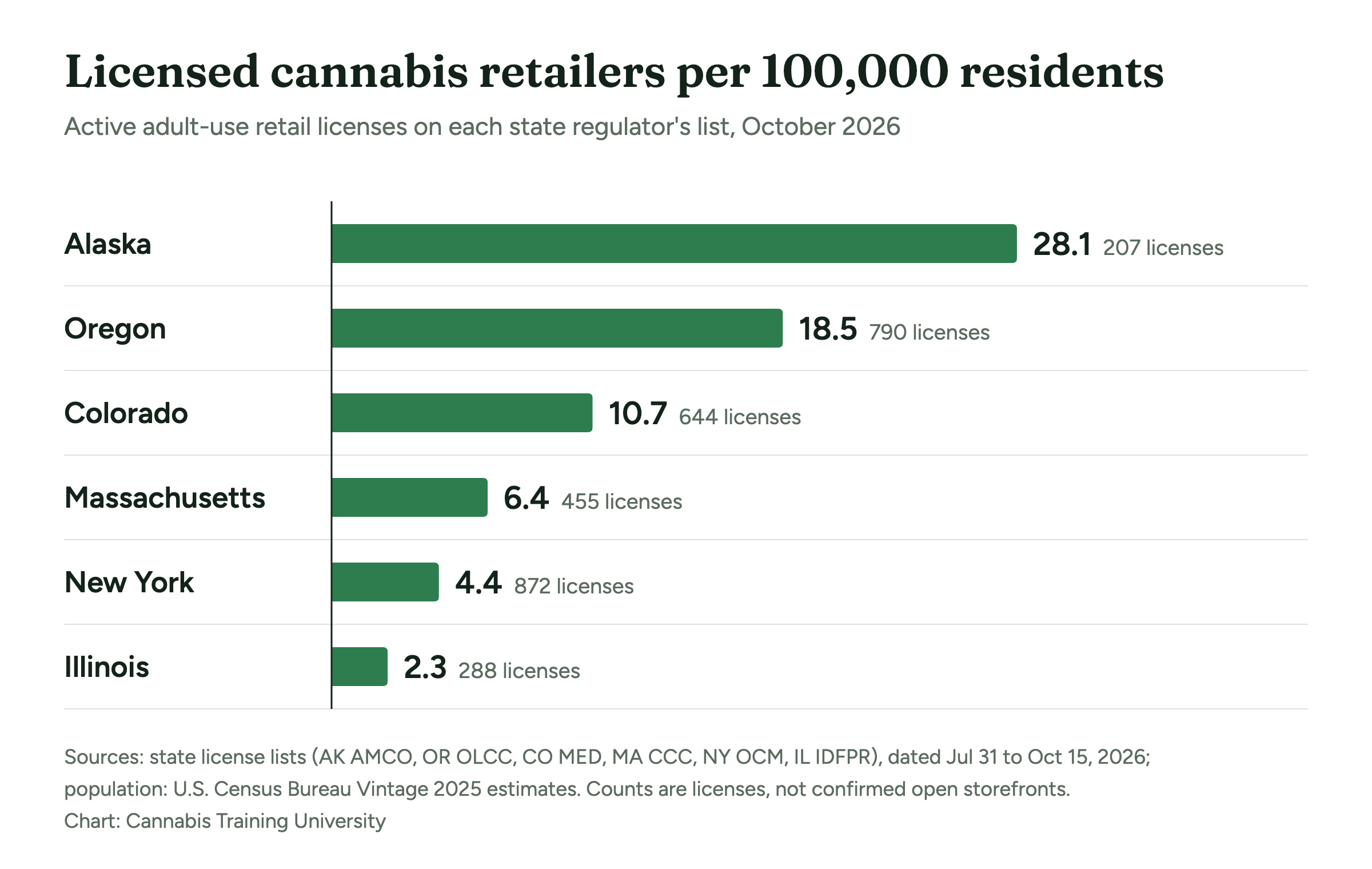
Oregon has more dispensaries per capita than any other state in the country, about 16.5 dispensaries per 100,000 residents.
Within the state, Portland, Eugene, Medford, Salem, and Bend stand at the top with the most dispensaries per capita.
If you want to get hired as a budtender check out the cities above or the following for dispensary positions:
Oregon requires anyone working in a dispensary to hold a Marijuana Worker Permit issued by the OLCC (Oregon Liquor and Cannabis Commission). Today, permits are managed entirely online through the CAMP (Cannabis and Alcohol Management Program) system.
Through CAMP you can:
If your application has errors or missing documents, the system flags it. You’ll typically have two weeks to fix issues or risk expiration of your temporary permit.
Pro Tip: Apply early, before you start job hunting. Processing time and background checks can delay your start date.
The OLCC exam isn’t about cultivation techniques — it’s all compliance. Expect questions on:
Flashcards or mock tests are great tools for quick recall. Passing with confidence helps you start your career on the right foot.
The worker permit is your ticket in, but employers increasingly value additional credentials. For example:
Having these extras on your resume demonstrates initiative and readiness.
Rules in Oregon’s cannabis industry evolve quickly. Employers look for budtenders who are not only aware of compliance basics but also tuned in to new regulations, such as:
Showing you keep up with changes signals that you’ll be an asset long-term.
A budtender’s daily duties in Oregon usually include:
Typical Pay: Budtenders in Oregon generally earn between $13.75 and $18 per hour, averaging around $15. Tips, commissions, and staff discounts often add significantly to total income.
Employers notice when candidates invest in training beyond the basics. Completing a comprehensive certification program or cannabis college signals that you’re career-focused and not just looking for short-term work.
Many hiring managers say it helps them separate applicants who are serious about building a career in cannabis from those who are only looking for an entry-level job.
Becoming a budtender in Oregon is a clear path, but it’s competitive. The basics — being 21+, securing your OLCC permit, and passing the compliance exam — will get you started. What sets you apart is how prepared you are beyond that.
By adding CTU certifications, understanding regulations, and building product knowledge, you’ll not only land the job but also grow in one of the fastest-moving industries in the state.
To work at an OLCC-licensed recreational marijuana business in Oregon you need an OLCC Marijuana Worker Permit, and to get it you must complete the OLCC marijuana education course and pass its test (OLCC worker permit, checked Oct 2026). Private budtender training isn’t required on top of the permit, but it can help you stand out from the competition.
Job applicants must be knowledgeable about the cannabis industry, strains, consumption methods, and effects. If you’re looking to brush up on the fundamentals of cannabis or learn from the ground up, sign up for CTU’s online budtender school.
CTU offers multiple courses covering cannabis cultivation, cannabis cooking, cannabis laws, cannabis medicine, cannabis extraction, and cannabis careers.
Our comprehensive curriculum takes you through every aspect of the cannabis industry from cultivation to retail. Our budtender training can help you get your foot in the door and walk through with confidence.
Now that you know how to become a budtender in Oregon, it’s time to make that dream a reality.
More in Jobs

Check your state's cannabis laws

Budtender / dispensary roles
 IACET Accredited Provider · online cannabis education
Since 2009 • 50,000+ students trained worldwide


Copyright Cannabis Training University, a subsidiary of Online Training Providers. © 2026. All Rights Reserved.
Medical Disclaimer: The information on this website is for informational purposes only and is not intended to be a substitute for professional medical advice, diagnosis, or treatment.
Always seek the advice of a physician or other qualified health provider with any questions you may have regarding a medical condition.
Legal Compliance: Cannabis remains federally illegal. Products and information are intended only for jurisdictions where cannabis use and possession is legal.
By using this site, you affirm that you are of legal age (21+) and responsible for understanding your local laws.