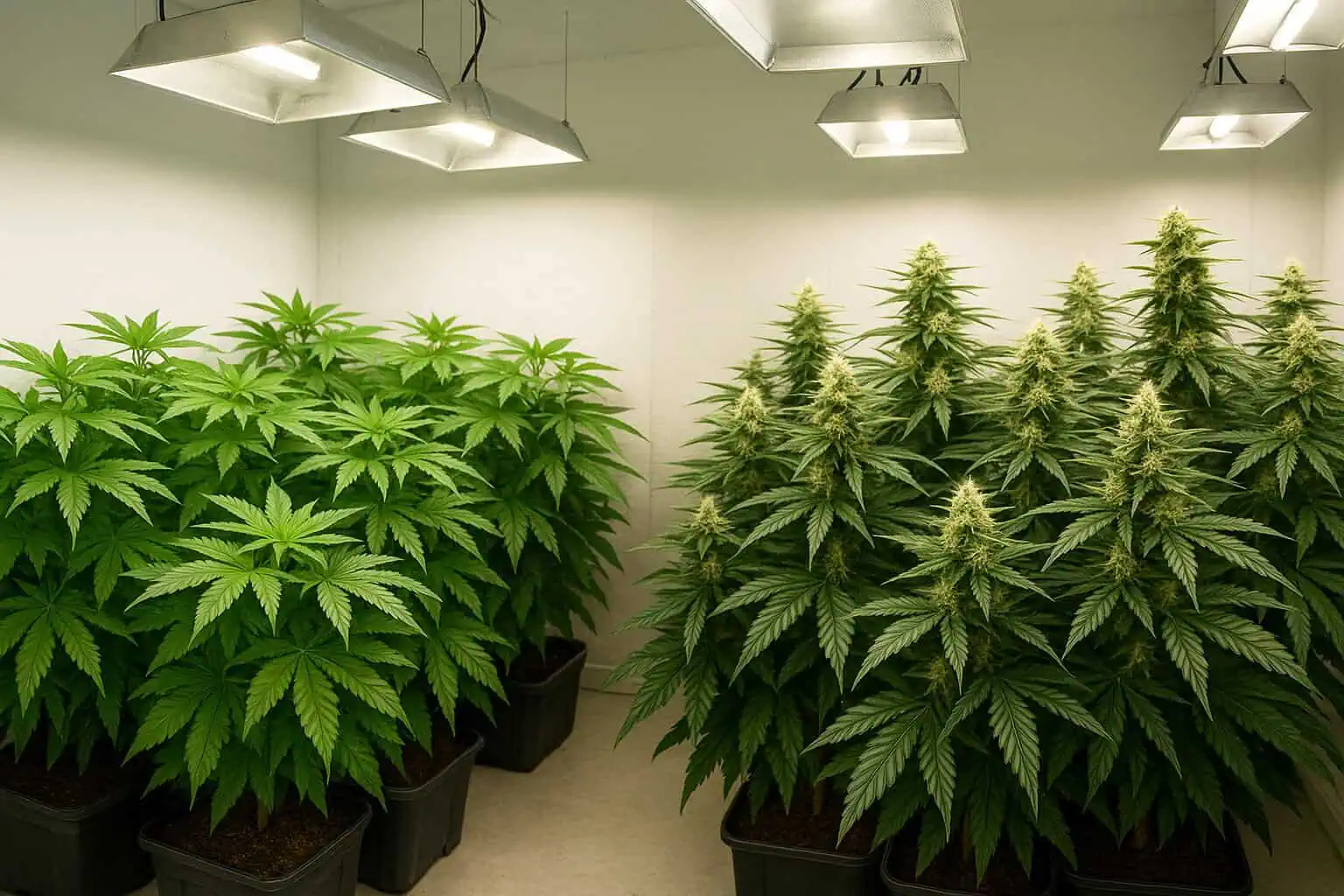
For those new to growing marijuana, knowing when to switch from vegetative to flowering stage can be challenging.
Below, we provide essential tips to help you make this transition smoothly, along with key insights about the marijuana growing process.
Autoflowering strains do not require changes to light cycles to initiate flowering, as they transition to the flowering stage automatically after a certain period of growth.
However, providing an optimal light schedule, such as 18-24 hours of light per day, can maximize their growth and yield
As a result, autoflowering strains produce significantly higher yields in indoor environments where light exposure can be optimized.
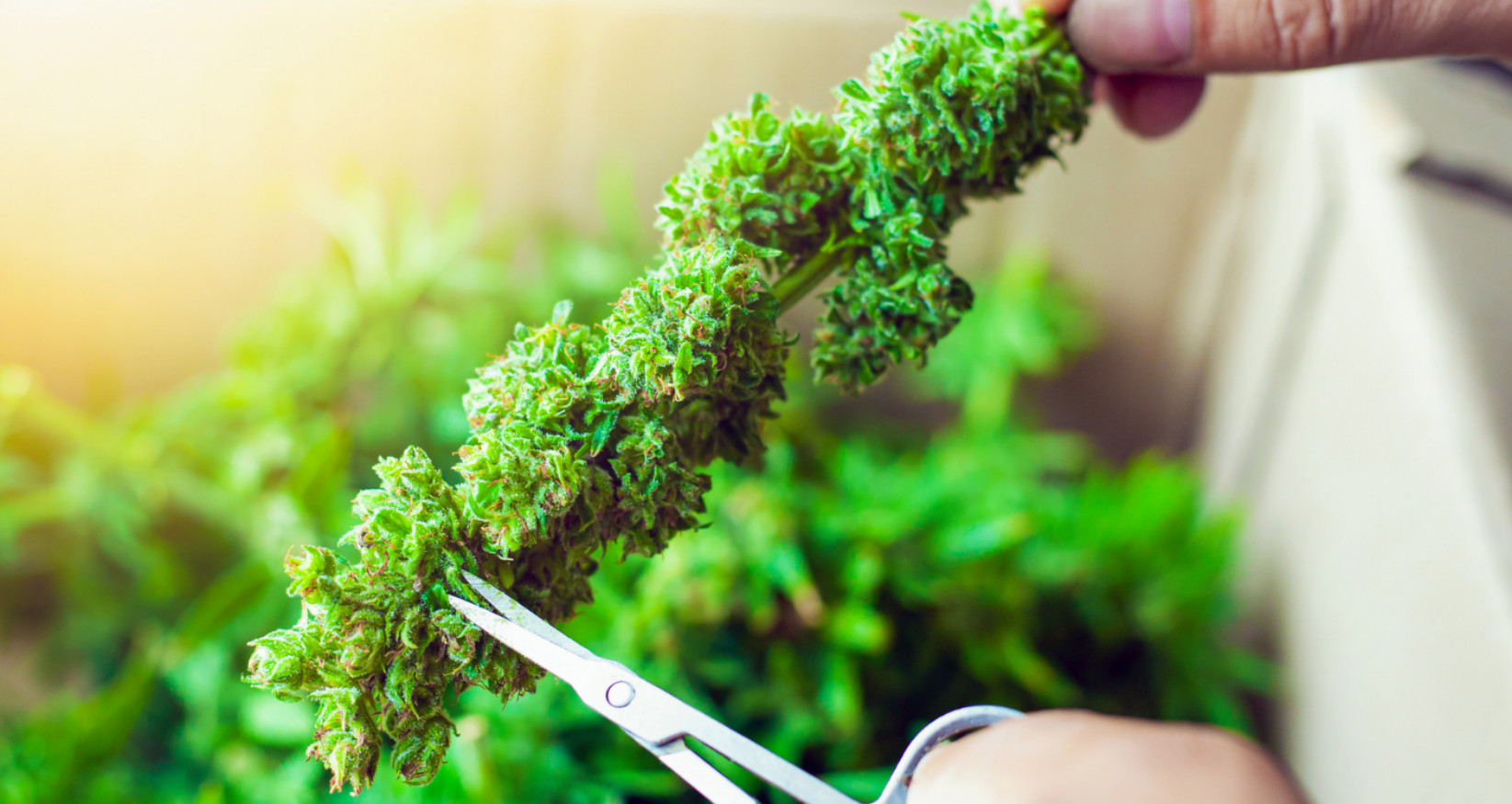
Flowering a plant too early can impact the yield and potency in a negative manner. There is a period of time where it will be best to flower your marijuana plants.
Beginners might have to deal with accidental flowering during vegetative if they do not keep light cycles consistent. When to switch from vegetative to flowering stage step by step instructions.
Grow it right the first time
Stop guessing. Learn to grow from seed to harvest.
The Indoor & Outdoor Cannabis Growing Certificate covers nutrients, pH, lighting, pests and harvest, with video lessons and a certificate when you finish.
See the Growing Certificate →Free Cannabis Cultivation Guide (ebook)IACET-accredited · 7-day money-back guarantee
Transitioning from the vegetative stage to the flowering stage must be timed correctly.
Most seeds you purchase will include information on the recommended number of days the plant should remain in the vegetative stage.
In the same way, the seeds will often tell you how long the plant will stay in the flowering phase.
Keeping in mind that the vegetative stage is around 2 to 4 weeks depending on the strain of cannabis you are growing.
You want the plant to establish a healthy root system before transitioning to flowering so the plant can support itself.
Indoors, it’s important to consider the size of the container you’re using for growing. A general guideline is to allow about one week of growth per gallon of soil, ensuring the plant has enough time to establish before flowering begins.
Growing cannabis outdoors allows nature to naturally transition your plants into the flowering stage.
The vegetative stage for outdoor cannabis growing requires planting at the appropriate time of year. Starting seeds in the summer ensures that natural light cycles will support growth, leading to a harvest around October.
Indoor cannabis grows are going to be very different as you can plant the seeds at any point as you will be controlling the environment.
You will likely need to reduce the light schedule from 18 hours to 12 hours per day to initiate the flowering stage, which can last up to 10 to 11 weeks depending on the strain.
Autoflowering strains can grow indoors or outdoors and need no switches in light time. Take your time as a first-time grower to see if you can maintain the plants rather than worrying if it is time to put your plants into the flowering stage.
If you want to drive up the yield make sure your autoflowering seeds are of a strain like Amnesia Haze which has massive yields per plant.
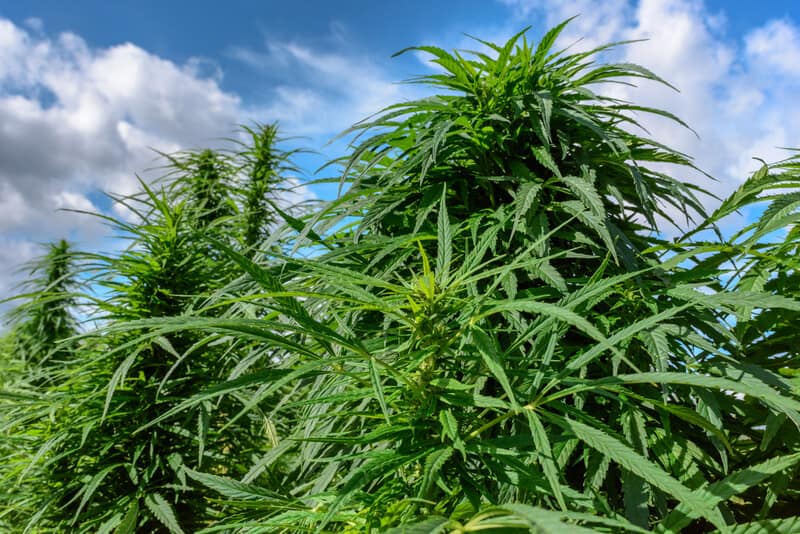
Seeds need to have strong genetics and should be of a strain that will thrive in your climate if growing outdoors.
There are states like Florida that might be too humid to grow a strain like OG Kush outdoors as the strain thrives in dryer environments that can be likened to Southern California.
Triangle Kush is an example of a strain that can grow well in Florida as the strain was originally bred there.
Nutrients should be used when growing in any condition as they can help your plants immensely. Too much of a good thing can be negative as you can actually damage them from adding too many nutrients.
Nutrient burn can happen on the leaves of the plant and can impact yield negatively.
Using too many chemicals or products near the harvest period can also impact the taste of your marijuana negatively.
Too much water is something that most people wouldn’t think could impact your yield in a negative manner.
Watering your plants during their dark hours is essential to ensure they can fully absorb the moisture.
Rainfall can also serve as sufficient watering for the day.
Additionally, it’s crucial to keep your grow tent well-ventilated to prevent excessive humidity, which can encourage mold growth on your plants.
Flowering your marijuana plants too early can lead to far lower yields. You want your plants to be strong before you start flowering them.
Research the strains that you are growing to make sure you fill your tent with plants that are similar to grow. This could also impact when you are supposed to plant your seeds outdoors if you want to harvest during the same time at the end of the season.
Switching cannabis plants from the vegetative stage into the flowering stage is one of the most critical moments in a grow. Doing it at the right time, and in the right way, sets the stage for yield, potency, and plant health.
Below is a deep-dive into everything you need to know: when to flip, how to prepare, what to expect, and frequently asked questions. This guide is designed to provide both beginner and advanced growers with a complete resource on when to switch from vegetative to flowering stage.
Cannabis plants move through two primary life stages before harvest: vegetative and flowering. In the vegetative stage, the plant is focused on building size, structure, and leaf mass. In the flowering stage, the plant shifts energy into bud production and resin development.
The transition point is crucial because it determines not only yield potential but also how well your space and resources will handle the plant’s natural stretching and budding.
Photoperiod cannabis strains flower based on the amount of light they receive. Indoors, growers must switch the light cycle from a vegetative schedule (commonly 18 hours light and 6 hours dark) to a flowering schedule of 12 hours light and 12 hours dark.
Outdoors, photoperiod strains naturally flower when days become shorter, typically in late summer.
Autoflowering strains do not depend on light cycles. They begin flowering automatically, usually within 2 to 3 weeks of sprouting, regardless of light schedule. This makes them simpler for beginners but gives less control over timing.
Most indoor growers switch their plants from 18/6 to 12/12 to initiate flowering. This sharp change mimics the natural shortening of days in late summer and signals the plant to begin producing flowers.
Some growers experiment with alternative light cycles such as 10 hours light and 14 hours dark, claiming it boosts resin production. However, this can reduce overall yields and stress some strains. The industry standard remains 12/12 for reliability.
A trick some cultivators use is to place their plants in 24 to 36 hours of uninterrupted darkness before flipping to 12/12.
This can help trigger a faster flowering response. However, extreme caution must be taken to avoid any light leaks during flowering, as even small interruptions in darkness can cause stress or hermaphroditism.
Knowing exactly when to switch is as much art as science. Here are the key indicators:
Most growers flip when their plants have reached about half the final desired height. This is because many strains stretch significantly after the flip, often doubling in size. Planning ahead avoids running out of vertical room or having buds too close to the grow lights.
A common vegetative period lasts between 3 to 5 weeks, though some growers veg longer if they have ample space. Flipping too early results in smaller plants and smaller yields. Flipping too late can overcrowd the grow room, block airflow, and reduce bud quality.
Many growers wait until plants display pre-flowers, small hair-like pistils that indicate sexual maturity. Once pre-flowers are present, flipping will lead to more robust flowering. If you flip before maturity, plants will still flower, but may yield less.
If you have topped, pruned, or performed low-stress training, it is best to give plants one to two weeks to recover before flipping. This ensures they enter flowering strong and unstressed.
Switching light schedules is not the only change that happens. Plants require a different environment and nutrient mix during flowering.
Flipping too early results in underdeveloped plants with low yields. Flipping too late leads to overcrowding, reduced light penetration, and increased risk of mold.
The sweet spot maximizes both yield and potency by letting plants build enough structure to support large buds while not outgrowing their space.
Stress management is another factor. Plants under stress during transition are more likely to develop problems. Avoid training, pruning, or transplanting immediately before or during the flip. Keep the transition as smooth as possible.
Yes, if plants are healthy and you want to control size. Yield may be smaller, but it is possible.
This is a good sign of maturity. Flipping shortly after is common practice and usually results in better yields.
Yes. Autoflowers do not require a light schedule change and finish quickly. However, they cannot be kept in veg longer to bulk up.
Some believe more darkness promotes stronger resin and potency. However, it usually reduces yields and stresses certain strains.
Most growers switch immediately. Some add an initial 24–36 hours of darkness first. Gradual changes are not necessary.
On average, plants double in height, though this varies with strain and environment.
Indica-dominant plants often respond quickly to 12/12 and may not stretch as much. Sativa-dominant plants may need longer dark periods to fully trigger flowering and can stretch significantly, sometimes tripling in height.
Reflective walls, correct light distance, and balanced air circulation become more important in flower. Lower humidity reduces the risk of mold. Enriching CO₂ levels can boost yields in sealed environments. Flowering plants thrive in slightly cooler nighttime temperatures, mimicking autumn conditions.
Growers often use Screen of Green (SCROG) or Low-Stress Training to manage canopy shape. These should be completed during veg, followed by recovery time, so plants are ready to focus on bud production after the flip.
During weeks 1–2, plants undergo stretch. By weeks 3–4, small budlets appear and trichome production begins. By weeks 6–10, depending on strain, buds swell, pistils darken, and trichomes shift from clear to cloudy or amber. This is the key harvest indicator.
Outdoors, photoperiod plants naturally transition to flowering when daylight drops below 12 hours, usually in late summer. While you cannot control this, you can influence it by light deprivation techniques to trigger earlier flowering in outdoor grows.
Week 1–3: Vegetative growth under 18/6 lighting. Plants build structure, leaves, and branches.
Week 3–5: Final veg stage. Train, prune, and allow recovery. Flip when plants reach about half of your vertical space.
Week 5–6: Pre-flower flip. Optionally use 24–36 hours of darkness, then switch to 12/12. Begin transition nutrients.
Weeks 6–7: Stretch phase. Plants rapidly increase height. Monitor and support.
Weeks 7–9: Bud formation begins. Lower humidity, provide balanced bloom nutrients, and maintain consistent dark cycles.
Weeks 9–12: Bud maturation. Monitor trichome color and pistil development. Support heavy branches.
Harvest: When trichomes are mostly cloudy with some amber and pistils have mostly darkened.
Switching from vegetative to flowering is one of the biggest milestones in cannabis cultivation.
The timing of the flip determines how much you can harvest, the potency of your buds, and the overall success of your grow.
The keys are understanding your strain, preparing the environment, managing plant stress, and keeping consistent light and dark cycles.
With careful planning and attention, your plants will reward you with dense, resinous buds that make all the effort worthwhile.
Here’a a checklist that shows when to switch from vegetative to flowering stage.

Learning to grow cannabis is a process as there are many factors that impact quality, yield, and potency.
Something as simple as seed genetics can set a grow up for failure as inferior genetics make for very sensitive and nondurable plants.
Finding seeds of the best quality is going to be of paramount importance. You should only rely on reputable seed banks online or seeds that you find at a dispensary.
The best seeds will have deep genetics and a lineage that makes it fun to grow. Trusting a seed seller on social media is a great recipe to grow a strain where you do not know what it is.
CTU offers top online marijuana growing classes so you can hone your skills from the comfort of home. Our courses will allow you to learn every phase of cultivating cannabis and even covers things like curing and clipping.
Growing incredible marijuana can lead to more professional opportunities in a flourishing industry that can provide job security for years to come.
Learning when to switch from vegetative to flowering stage is just a small step in the cannabis cultivation process.
More in Growing

Check your state's cannabis laws

Indoor + outdoor growing careers
 IACET Accredited Provider · online cannabis education
Since 2009 • 50,000+ students trained worldwide
IACET Accredited Provider · online cannabis education
Since 2009 • 50,000+ students trained worldwide



Copyright Cannabis Training University, a subsidiary of Online Training Providers. © 2026. All Rights Reserved.
Medical Disclaimer: The information on this website is for informational purposes only and is not intended to be a substitute for professional medical advice, diagnosis, or treatment.
Always seek the advice of a physician or other qualified health provider with any questions you may have regarding a medical condition.
Legal Compliance: Cannabis remains federally illegal. Products and information are intended only for jurisdictions where cannabis use and possession is legal.
By using this site, you affirm that you are of legal age (21+) and responsible for understanding your local laws.