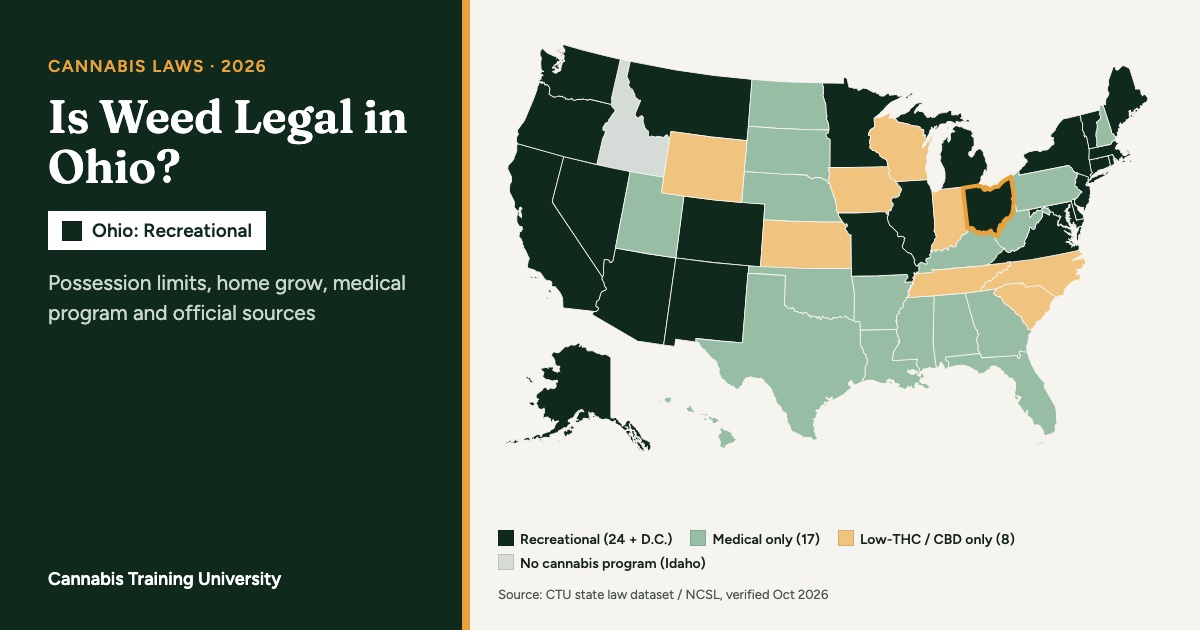
State cannabis laws · OH
Ohio cannabis laws (2026)
Ohio allows both medical cannabis (legalized in 2016 under House Bill 523) and adult-use recreational cannabis for adults 21 and older (approved by voters as Issue 2 in November 2023), both regulated together by the Division of Cannabis Control under Ohio Revised Code Chapter 3796.
RecreationalPossession
Legal age
Home grow
Medical card
Delta-8 THC
Driving (DUI) limit
From the CTU state cannabis law dataset (September 28, 2026), checked against official state sources (numbers point to the Sources list). Facts we have not confirmed on an official source are left out until they are.
Ohio allows both medical cannabis (legalized in 2016 under House Bill 523) and adult-use recreational cannabis for adults 21 and older (approved by voters as Issue 2 in November 2023), both regulated together by the Division of Cannabis Control under Ohio Revised Code Chapter 3796. Hemp with no more than 0.3% THC is legal and regulated separately under Chapter 928. Senate Bill 56, effective March 20, 2026, merged the former adult-use chapter into Chapter 3796 and banned intoxicating hemp-derived products, including many delta-8 THC items, that exceed 0.4 mg of total THC per container.
Federal hemp change: from December 11, 2026 the federal definition of hemp counts total THC, including THCA, and final hemp products with more than 0.4 mg of total THC per container are no longer hemp; products with cannabinoids the plant cannot naturally produce stop counting as hemp on November 12, 2026. What changes, state by state (P.L. 119-37 § 781; P.L. 119-103 § 2019).
Official sources ORC 3796.221 Rights of adult-use users (eff. 3/20/2026) 1 · ORC 3796.22 Rights of registered patient (eff. 3/20/2026) 2 · Ohio Revised Code 2925.11 – Possession of Controlled Substances 3 · Division of Cannabis Control (DCC) – Ohio Department of Commerce 9 · Ohio Revised Code Chapter 928 – Hemp and Hemp Products 10
Ohio voters legalized adult-use cannabis for people 21 and older through the November 2023 Issue 2 ballot measure, with retail sales beginning August 6, 2024 through licensed dual-use dispensaries. The Division of Cannabis Control regulates cultivation, processing, testing, and retail sale, with a statewide cap of 400 dispensaries.
Official sources ORC 3796.221 Rights of adult-use users (eff. 3/20/2026) 1 · Ohio Revised Code Chapter 3796 – Marijuana Control Program 4 · Division of Cannabis Control (DCC) – Ohio Department of Commerce 9
The Ohio Medical Marijuana Control Program, created in 2016, registers patients diagnosed with one of 21 listed qualifying conditions (plus any the State Medical Board later adds) after a physician holding a state certificate to recommend confirms the diagnosis. Registration is free and a patient card is valid for one year. Registered caregivers may obtain and administer product for patients, capped at the patient's 90-day supply, and must keep separate inventories when serving more than one patient.
How to get a medical marijuana card
Official sources ORC 3796.22 Rights of registered patient (eff. 3/20/2026) 2 · Ohio Cannabis FAQ – Division of Cannabis Control 5 · Ohio Revised Code Chapter 3796 – Marijuana Control Program 4 · Rule 1301:18-10-01 – Ohio Administrative Code 11 · Rule 4731-32-03 – Ohio Administrative Code 12
Adults 21 and older may possess up to 2.5 ounces of cannabis flower and 15 grams of extract. Registered medical patients may possess up to 2.5 ounces of plant material plus cannabis products with up to 15,000 mg of total THC at any time; they may carry up to 10 ounces of plant material home from a dispensary with the receipt, and may keep no more than a 90-day supply at their primary residence. Possessing more than the legal amount is a crime under ORC 2925.11, starting as a minor misdemeanor and rising to a felony as the weight increases.
Official sources ORC 3796.221 Rights of adult-use users (eff. 3/20/2026) 1 · Ohio Revised Code Chapter 3796 – Marijuana Control Program 4 · Rule 1301:18-10-03 – Ohio Administrative Code 6 · Ohio Revised Code 2925.11 – Possession of Controlled Substances 3
At a licensed dispensary, both medical patients and adult-use consumers 21 and older may buy up to 2.5 ounces of flower, six seeds/clones/live plants, and 15,000 mg of total THC in other products per day. Only registered medical patients (not caregivers or non-medical consumers) may buy up to four days' worth of product in one transaction.
Official sources Ohio Cannabis FAQ – Division of Cannabis Control 5 · Ohio Revised Code Chapter 3796 – Marijuana Control Program 4
Adults 21 and older may grow up to six cannabis plants each, and up to 12 per household with more than one adult, at their primary residence in a secured, enclosed area not visible from public view. Growing on behalf of someone else, selling homegrown cannabis, and using hydrocarbon extraction on it are all prohibited, and the same homegrow right applies to medical patients since there is no separate medical-only home grow allowance.
Official sources ORC 3796.04 Home grow (eff. 3/20/2026) 7 · Ohio Cannabis FAQ – Division of Cannabis Control 5
Possessing cannabis within the legal adult-use or medical limits is not a crime. Above those limits, ORC 2925.11 penalizes possession on a sliding scale by weight, from a minor misdemeanor with no criminal record up to a second-degree felony for very large amounts; illegal cultivation and unlicensed sale/trafficking are charged and scaled similarly. Driving with a marijuana concentration at or above the state's per se limits (2 ng/mL in blood) is an OVI, carrying mandatory jail time, fines starting at $565, and a license suspension.
Official sources Ohio Revised Code 2925.11 – Possession of Controlled Substances 3 · Ohio Revised Code Chapter 3796 – Marijuana Control Program 4 · Ohio Revised Code 4511.19 – Operating a Vehicle Under the Influence (OVI) 8 · Section 2953.321 – Ohio Revised Code 13
Licensed dispensaries may sell flower, extracts, edibles, beverages, tinctures, topicals, patches, and inhalers, with THC content capped at 35% for plant material and 70% for extracts (medical smoking/combustion is banned). Products must use child-resistant packaging and be labeled with their THC and CBD content, among other required information.
Federal hemp change: from December 11, 2026 the federal definition of hemp counts total THC, including THCA, and final hemp products with more than 0.4 mg of total THC per container are no longer hemp; products with cannabinoids the plant cannot naturally produce stop counting as hemp on November 12, 2026. What changes, state by state (P.L. 119-37 § 781; P.L. 119-103 § 2019).
Official sources Ohio Cannabis FAQ – Division of Cannabis Control 5 · Ohio Revised Code Chapter 928 – Hemp and Hemp Products 10 · Ohio Revised Code Chapter 3796 – Marijuana Control Program 4
Adult-use cannabis sales carry a 10% state excise tax on top of Ohio's standard 5.75% state sales tax (plus any local sales tax); medical marijuana purchases are exempt from the 10% excise tax. Local governments may not impose their own additional cannabis-specific taxes or fees. Excise tax revenue funds the Adult Use Tax Fund, split between host communities with dispensaries and the state general revenue fund.
Official sources Ohio Revised Code Chapter 3796 – Marijuana Control Program 4 · Section 5739.02 – Ohio Revised Code 14 · Ohio Cannabis FAQ – Division of Cannabis Control 5
Cultivators, processors, testing laboratories, and dispensaries must be licensed by the Division of Cannabis Control. The state caps dispensaries at 400 and uses an evaluation/lottery process for new licenses, including a 15% set-aside for specified economically disadvantaged groups. The same entity may hold both cultivator and dispensary licenses (vertical integration is allowed), and Ohio residency is not generally required of owners outside that equity set-aside.
Official sources Division of Cannabis Control (DCC) – Ohio Department of Commerce 9 · Ohio Revised Code Chapter 3796 – Marijuana Control Program 4 · Rule 1301:18-2-09 – Ohio Administrative Code 15 · Ohio Cannabis FAQ – Division of Cannabis Control 5 · Rule 1301:18-5-03 – Ohio Administrative Code 16
Every fact on this page comes from the CTU state cannabis law dataset and is checked against the official government sources below. The numbers match the markers next to each fact and section. Page last reviewed October 15, 2026.
Facts we could not confirm on an official government source are left off this page. Statutes are linked to the state’s own legislature or code site, never to a private copy.
Free to quote and link for research, teaching and news. Please name Cannabis Training University, link this page and give the review date.
APA
Cannabis Training University. (2026, October 15). Is weed legal in Ohio? Ohio cannabis laws (2026). https://cannabistraininguniversity.com/laws/is-weed-legal-in-ohio/
MLA
“Is Weed Legal in Ohio? Ohio Cannabis Laws (2026).” Cannabis Training University, 15 Oct. 2026, cannabistraininguniversity.com/laws/is-weed-legal-in-ohio/.
Free to use: download the data (CSV) or add the map to your website.
Official sources Rule 1301:18-10-01 – Ohio Administrative Code 11 · Ohio Revised Code Chapter 3796 – Marijuana Control Program 4 · Ohio Cannabis FAQ – Division of Cannabis Control 5 · National Park Service – Shenandoah: alcohol and marijuana policy 17 · TSA – What can I bring? Medical marijuana 18
Cannabis Training University teaches cannabis skills online: budtending, growing and running a cannabis business.
Adults 21 and older with a valid government ID can buy from licensed dispensaries in Ohio.
Simple possession of marijuana at or under 100 grams (above the legal 2.5 oz/15g adult-use and medical limits) is a minor misdemeanor with no jail and no criminal record; the penalty increases with weight above that.
Adult visitors 21+ can buy and use cannabis in Ohio under the same limits as residents, in private places where use is allowed. The Division of Cannabis Control may negotiate reciprocity agreements recognizing another state's medical marijuana registry card if that state's eligibility standards are comparable and it reciprocally recognizes Ohio's card.
Adults 21 and older may grow up to six cannabis plants each, and up to 12 per household with more than one adult, at their primary residence in a secured, enclosed area not visible from public view.
No. From December 11, 2026 the federal hemp definition counts total THC, including THCA; products with cannabinoids the plant cannot naturally produce stop counting as hemp on November 12, 2026.
Recreational cannabis is already legal in Ohio.
Adults 21 and older may possess up to 2.5 ounces of cannabis flower and 15 grams of extract.
Find it in Ohio
Check another state's cannabis laws
Pick your state to see possession limits, home grow rules and the official source.
More in Laws


Compliance, regulations, risk reduction
 IACET Accredited Provider · online cannabis education
Since 2009 • 50,000+ students trained worldwide



Copyright Cannabis Training University, a subsidiary of Online Training Providers. © 2026. All Rights Reserved.
Medical Disclaimer: The information on this website is for informational purposes only and is not intended to be a substitute for professional medical advice, diagnosis, or treatment.
Always seek the advice of a physician or other qualified health provider with any questions you may have regarding a medical condition.
Legal Compliance: Cannabis remains federally illegal. Products and information are intended only for jurisdictions where cannabis use and possession is legal.
By using this site, you affirm that you are of legal age (21+) and responsible for understanding your local laws.