Have you ever walked into a cannabis dispensary and wondered what the terms sativa and indica mean? Countless individuals scratch their heads when a budtender calls a strain sativa-dominant or indica-leaning. What about indica vs sativa vs hybrid strains? Gets you even more confused?
Not knowing what type of weed you’re smoking can lead to unpleasant experiences or just keep you away from that perfect cannabis strain that’s just right for you.
This ultimate guide offers essential insight into the traits, benefits, and characteristics of indica and sativa cannabis strains.
Love this strain? Grow it yourself
Learn to grow strains like this at home.
The Indoor & Outdoor Cannabis Growing Certificate takes you from seed to harvest: genetics, nutrients, lighting, pests and curing, with video lessons and a certificate when you finish. Learn at your own pace.
See the Growing Certificate →Free Cannabis Cultivation Guide (ebook)IACET-accredited · 7-day money-back guarantee
Indica strains are typically found in various environments around the globe that are mountainous, cold, dry, and hot. These areas are Nepal, Pakistan, Afghanistan, Uzbekistan, Western China, and Morocco.
Due to cold winters and hot summers, along with harsh conditions, such as high wind speeds – strains within the indica range grow short, bushy, and produce dense flowers.
When you look at a pure indica cannabis strain, you’ll notice that the leaves are large and wide.
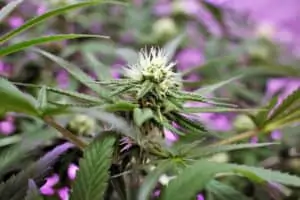
For cultivators, the ultra-dense flowers of indica strains are both a blessing and a curse. Most consumers demand dense flowers; however, this comes at a cost.
Dense flowers retain more moisture than airy flowers, which makes them more susceptible to bud rot. Bud rot can quickly proliferate and destroy a cannabis crop – especially indica-dominant strains that are left in humid environments too long.
As a cannabis cultivator, it’s essential to monitor the dense flowers from indica cannabis strains.
However, indica-dominant cannabis strains flower quickly to beat the harsh winter that lies ahead. This is why indica cannabis strains are so popular to produce – they can be harvested in as little as 6-weeks from the onset of the flowering stage.
Due to the quick flowering process they must grow dense to fend off the dry and hot environment from sucking away the internal moisture. It’s for this protective reason that indica strains are compact. If it wasn’t for this trait, the flower wouldn’t live to be pollinated.
Current research shows the effects of cannabis strains are attributed to lesser-known compounds called terpenes. All plants contain terpenes, as they play a role in attracting potential pollinators and deflecting would-be predators.
In the case of indica-dominant cannabis strains, the primary terpene that’s responsible for the “couch-lock” effect is myrcene.
When a cannabis strain contains more than 0.05% myrcene, the likelihood of the strain presenting sleep-inducing effects becomes very high.
For one reason or another, indica cannabis strains tend to contain a large concentration of myrcene, which explains why indica cannabis strains are associated with incredibly calming effects.
Furthermore, myrcene is also responsible for muscle-relaxing qualities.
This is why many budtenders will recommend a strong indica when you’re dealing with chronic pain, insomnia, and anxiety.
Indica cannabis strains offer consumers with a full-body experience that’s sure to please those seeking relaxing effects.
However, it’s not only recreational users that can benefit from indica cannabis strains. Medical marijuana patients are prone to choosing indica cannabis strains over sativas because they provide a multitude of therapeutic effects.
Various effects that indica cannabis strains are known to provide:
Many medical marijuana patients use indica cannabis strains to support various medical issues, such as:

Sativa strains differ from indicas because they are found in warm and humid environments.
Locations, such as Thailand, Mexico, Panama, Colombia, South Africa, Mozambique, Vietnam, and Laos, are all regions where sativas grow naturally.
Sativa strains are tall and skinny instead of short and bushy. Since sativas grow in tropical regions, the competition for sunlight is extremely high. Sativa plants have adapted to this challenge by growing tall and reaching for the light.
Furthermore, due to the long summers that are common in these regions, sativa strains flower for a much longer period when compared with indicas.
On average, sativa cannabis strains flower between 10-16-weeks, which makes them more difficult to cultivate.
Since sativa strains grow in humid environments, they don’t need to produce dense flowers.
Instead, sativas are known to produce large and airy flowers to prevent any instance of bud rot.
From the cultivation perspective, sativa strains are more complicated to produce than indicas. The primary reason behind this is the long flowering time and a general nutrient sensitivity.
Although sativa strains are very difficult to grow – they are wildly popular among cannabis enthusiasts.
Cannabis cultivators must take special precautions when growing sativa strains because they can take double the time that an indica flower can. If you thought flowering a strain in 8-weeks was difficult – imagine 16-weeks.
The yields from sativa plants far outweigh those of indica-dominant cannabis plants.
Sativa strains are known as monster yielders, which is why many cannabis cultivators look towards sativa-dominant strains when producing for commercial purposes.
Although the yields are significant, sativa strains are far less dense when compared to indica strains. However, it’s a win-win situation for the cannabis cultivator because there is a lower chance that the final harvest will contract bud rot.
Although each person may perceive or react differently to a sativa strain, the effects are typically viewed as energetic, creative, social, psychedelic, and incredibly uplifting.
Limonene and pinene are common terpenes found in sativa strains.
Research shows that limonene is responsible for the motivating and uplifting effects that users experience when consuming sativa cannabis strains.
Pinene is known as a mood enhancer and empowers you with laser-like focus.
From a medical perspective, limonene is known to relieve stress, reduce anxiety, decrease pain, and even help with cancer symptoms. Pinene is known to help reduce asthma, ulcers, inflammation, and anxiety.
Instead of relying on the THC percentage, ask your local budtender to provide you with a full terpene analysis so that you can find a sativa strain with a high concentration of limonene, pinene, and more.
One of the most popular reasons that users consume sativa cannabis strains is because they help with social anxiety.
Sativa cannabis strains are well known to provide a hearty dose of the munchies. If you find that you’re lacking an appetite, then sativa cannabis strains may hold the key in activating your taste buds for anything in the fridge.
Hybrids are the result of crossing an indica and sativa strain together. The offspring of this cross is known as a hybrid because it contains the traits of both the indica and sativa parents.
The introduction of hybrids has made the job of knowing the differences between indicas and sativas even more difficult. Prior to hybrids, discerning a sativa from an indica was routine. Now, hybrids contain indica and sativa traits, which can be seen as beneficial or detrimental.
However, hybrids are commonly referred to as being indica-dominant or sativa-dominant. The dominant attachment connotes which type is commanding the overall experience.
For example, a sativa-dominant hybrid produces sativa-like effects. An indica-dominant hybrid will generate relaxing effects that are typically found in indica strains.
As each year passes, thousands of new hybrids enter the cannabis industry. This is why it’s imperative that you understand the differences between indicas and sativas.
Although hybrids are more difficult to categorize by sight and smell – lab tests will get to the bottom of the matter.
Remember, any strain that contains over 0.05% myrcene will lead to typical indica-like effects. Strains that are dominant in limonene and pinene are likely to exhibit sativa-like effects.
It should also be noted that hybrids can even offer a 50/50 split of indica and sativa effects.
If you find yourself keen to feel uplifted at first and relaxed during the “come down,” then true hybrids may be right for you.
Choosing the right hybrid marijuana seeds or clones for your garden can be the difference between a successful and poor yield.
Hybrid strains fall somewhere in the middle when it comes to growing them. Flowering times, growth patterns, and yields will vary depending on their genetics.
For instance, a hybrid pot strain may inherit the fast flowering time of an indica and the energizing effects of a sativa. Or, it can have a long flowering time of a sativa with the relaxing effects of an indica.
You can find a variety of hybrid marijuana seeds for sale from licensed dispensaries and online seed banks.
Do you want to learn how to grow cannabis at home? Check out our guide on how to grow cannabis from seed in 10 easy steps.
While Sativa and Indica terms remain popular in dispensaries, modern cannabis science shows that these botanical categories don’t accurately predict effects. Instead, the industry is shifting toward Chemovar (Chemotype) classification, which is based on the plant’s chemical profile—particularly its THC:CBD ratio and dominant terpenes.
Key Takeaway: Effects are best predicted by a combination of Chemovar Type + Terpene Profile, rather than whether the strain is labeled Sativa, Indica, or Hybrid.
Beyond THC, several lesser-known cannabinoids play crucial roles in shaping the cannabis experience.
Adding these minor cannabinoids to the conversation helps explain why some strains feel “heavier” or more calming than others with the same THC percentage.
Here are some widely recognized strains that demonstrate how classification, terpenes, and cannabinoids interact:
| Category | Strain Examples | Dominant Terpenes | Common Experience |
|---|---|---|---|
| Indica | Northern Lights, Granddaddy Purple, Kush varieties | Myrcene, Linalool, Caryophyllene | Full-body relaxation, potential for sleep, “couch-lock.” |
| Sativa | Sour Diesel, Jack Herer, Green Crack | Limonene, Pinene, Terpinolene | Uplifting, creative, energetic, focus-driven. |
| Hybrid | Gelato, Wedding Cake, Runtz | Caryophyllene, Limonene, Humulene | Balanced mix of body calm and mental uplift, depending on genetics. |
How cannabis is consumed often influences the experience more than strain labels alone.
Finally, cannabis effects vary from person to person because of individual biology and context.
Just because a strain affects someone in a certain way, doesn’t mean it will affect you the same.
It is important to start with good genetics when growing marijuana. Knowing the difference between sativa vs. indica vs. hybrids will help you decide which is best for you.
If you are wanting to learn how to grow marijuana, it is good to know about the differences in strains.
To learn more about sativa vs. indica vs. hybrid strains, check out how to grow marijuana.
Traditionally, Indicas are thought to provide more relaxing, body-heavy effects, while Sativas are associated with energy, creativity, and focus. However, these categories are not always reliable. Modern cannabis science shows that effects are more accurately predicted by the plant’s cannabinoid ratio (THC:CBD) and dominant terpenes.
Yes. Most cannabis today is a Hybrid, bred to combine traits of both. A Hybrid can be Sativa-dominant, Indica-dominant, or balanced, offering a wide range of effects. Hybrids are often chosen for their versatility.
Many Indica strains contain higher levels of myrcene and linalool, terpenes linked to calming, sedative qualities. Combined with THC, these compounds can make Indicas more effective for relaxation, pain relief, or sleep.
Sativa-leaning strains often feature limonene, pinene, or terpinolene, terpenes associated with uplifted mood, focus, and creativity. While many users find Sativas energizing, effects still vary depending on personal tolerance and mindset.
Don’t just rely on the label. Look at the chemovar type (THC-dominant, CBD-dominant, or balanced) and dominant terpenes. For relaxation or sleep, seek strains rich in myrcene or linalool. For energy and focus, look for limonene or pinene. For a mix, Hybrids are a good choice.
A Chemovar is a modern way of classifying cannabis by its chemical makeup instead of its plant shape. The three main types are: Type I (THC-dominant), Type II (balanced THC:CBD), and Type III (CBD-dominant). This system more accurately predicts effects than Indica/Sativa labels.
CBN (cannabinol), a byproduct of THC, is strongly associated with sedative effects. When paired with the terpene myrcene, it can amplify the “couch-lock” feeling often linked to Indica strains.
Yes. Edibles often produce more body-heavy, sedative effects regardless of the strain because the liver converts THC into 11-hydroxy-THC, a more potent compound that lasts longer.
For edibles, start with 2.5–5 mg THC and wait at least two hours before taking more. For smoking or vaping, try just one or two puffs to gauge the effect. Always follow the golden rule: Start Low and Go Slow.
Cannabis interacts with each person’s endocannabinoid system, tolerance level, mindset, and environment. These personal factors explain why two people can use the same strain but experience very different effects.
More in Strain Guides

Check your state's cannabis laws

Cannabis 101, labeling, retail education
 IACET Accredited Provider · online cannabis education
Since 2009 • 50,000+ students trained worldwide
IACET Accredited Provider · online cannabis education
Since 2009 • 50,000+ students trained worldwide



Copyright Cannabis Training University, a subsidiary of Online Training Providers. © 2026. All Rights Reserved.
Medical Disclaimer: The information on this website is for informational purposes only and is not intended to be a substitute for professional medical advice, diagnosis, or treatment.
Always seek the advice of a physician or other qualified health provider with any questions you may have regarding a medical condition.
Legal Compliance: Cannabis remains federally illegal. Products and information are intended only for jurisdictions where cannabis use and possession is legal.
By using this site, you affirm that you are of legal age (21+) and responsible for understanding your local laws.